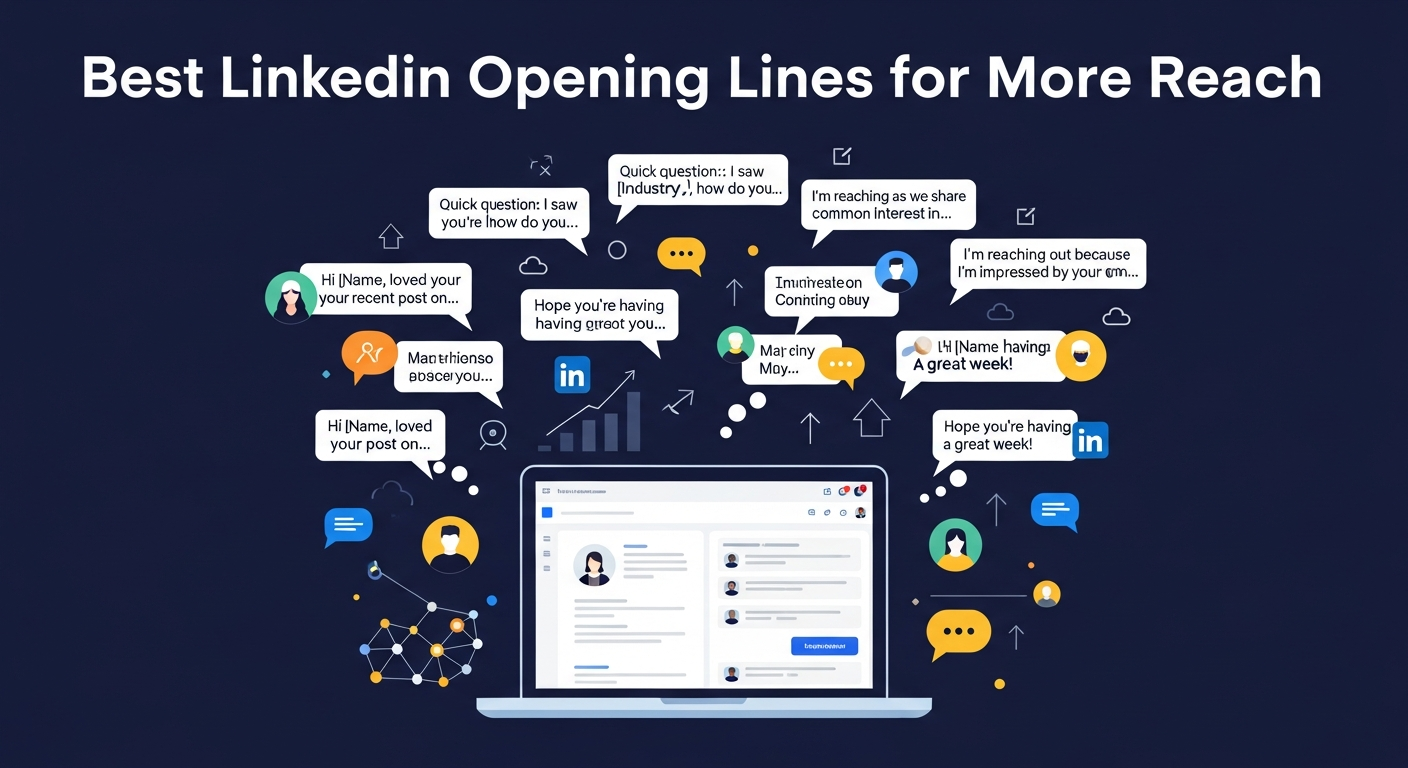
Best LinkedIn Opening Lines for More Reach

sushakanaujia
Author
Introduction: Stop Getting Ignored on LinkedIn!
Are your LinkedIn connection requests disappearing into the digital abyss? In today’s competitive professional landscape, a generic, “I’d like to add you to my network” simply won’t cut it. It’s the equivalent of showing up to a high-stakes networking event wearing a “Hello, My Name Is: Forgettable” nametag.
The truth is, a powerful LinkedIn opening line is your digital handshake – the key to unlocking a world of opportunities. From landing your dream job and forging valuable partnerships to generating qualified leads, a strategic connection request can open doors you never thought possible.
This comprehensive guide is your blueprint for crafting connection requests that not only get accepted but also spark meaningful conversations. We’ll delve into the art of personalized outreach, backed by data-driven strategies and proven methods, equipping you with the tools you need to build a thriving and engaged LinkedIn network in 2026.
What You’ll Learn:
- Why your LinkedIn opening line is crucial (and how to make it count).
- The P.V.C. Framework: Personalization, Value, and Context – the building blocks of a winning request.
- 17+ Customizable LinkedIn opening line templates for diverse professional goals.
- How to optimize your LinkedIn profile to attract the right connections.
- Common mistakes to avoid (and how to fix them).
- How to track and A/B test your opening lines for maximum impact.
- Leveraging AI tools to craft personalized and engaging connection requests.
Ready to transform your LinkedIn strategy? Let’s dive in!
Why Your LinkedIn Opening Line Matters: The 7-Second First Impression
In the age of instant gratification, first impressions are paramount. Research shows you have approximately 7 seconds to capture someone’s attention online. Your LinkedIn opening line is your opportunity to make those seconds count.
A compelling opening line does more than just say “hello”; it demonstrates that you’ve invested time in understanding the other person’s interests, career aspirations, or achievements. It signals a genuine interest in building a valuable connection, not simply expanding your network for the sake of numbers.
Think of it this way: Imagine attending a conference and being approached by someone launching into a generic sales pitch. You’d likely tune them out, right? The same principle applies to LinkedIn. If your opening line is impersonal and self-serving, it’s unlikely to resonate.
The Anatomy of a Winning LinkedIn Opening Line: Mastering the P.V.C. Framework
A great LinkedIn opening line doesn’t just introduce you; it builds a bridge. The P.V.C. Framework provides a simple, effective structure for crafting requests that get results:
- Personalization: Demonstrates that you’ve done your homework.
- Value: Offers something of interest or benefit to the recipient.
- Context: Makes your message relevant to their current situation or interests.
Let’s break down each element:
1. Personalization: Show You’ve Done Your Research
This is where you prove you’ve actually looked at their profile and understand their background, interests, and goals. Mention a recent article they shared, a project they worked on, a shared connection, or something specific about their company.
Example: “Hi [Name], I noticed you’re also a member of the [LinkedIn Group] and found your insights on [Specific Topic] particularly insightful.”
2. Value: What Can You Offer?
What can you bring to the table? It could be a valuable resource, a helpful connection, a unique perspective, or even just genuine admiration. Think about how you can contribute to their professional growth or success.
Example: “I’ve been following your work at [Company] for a while, and I was impressed with your [Specific Project]. I have some insights on [Related Topic] that I think you’d find valuable, especially regarding [Specific area].”
3. Context: Make It Relevant
Tailor your message to their current situation or interests. Are they actively looking for a job? Are they working on a specific project? Have they recently achieved something noteworthy? Tailor your message accordingly.
Example: “Congratulations on your recent promotion at [Company], [Name]! I’m always impressed by the innovation happening there, especially regarding [Specific Initiative].”
17+ Proven LinkedIn Opening Line Templates (Tailored for Specific Goals)
Crucial Reminder: These are templates, not scripts. Always personalize them to fit the individual you’re reaching out to. Generic personalization is still generic!
- The “Shared Connection” Approach:
- Template: “Hi [Name], [Mutual Connection] suggested I reach out. I’m impressed by your work in [Industry/Area] and would love to connect and learn more about your experience.”
- When to Use: When you have a mutual connection who can vouch for you.
- The “Content Compliment” Opener:
- Template: “Hi [Name], I really enjoyed your recent article on [Topic] in [Publication/Platform]. Your point about [Specific Point] resonated with me, especially [Your Reason]. Would love to connect and discuss further.”
- When to Use: When you’ve genuinely read and appreciated their content.
- The “Event Attendee” Intro:
- Template: “Hi [Name], I noticed you attended [Event]. I was there too! What were your key takeaways, particularly regarding [Specific Speaker/Topic]?”
- When to Use: After attending a conference, webinar, or industry event.
- The “Job Seeker’s” Connector (Targeting Recruiters):
- Template: “Hi [Recruiter Name], I’m a [Your Profession] with [X Years] of experience in [Specific Skill]. I’m actively seeking opportunities in [Industry] and would love to connect to learn more about roles at [Company], especially those related to [Specific Skill].”
- When to Use: When actively seeking a job and targeting recruiters.
- The “Sales Pro’s” Prospector (Targeting Potential Clients):
- Template: “Hi [Prospect Name], I’ve been following [Company Name]’s work in [Industry] and I’m impressed with [Specific Initiative/Achievement]. I help companies like yours improve [Specific Metric] through [Your Service]. Would be happy to share relevant case studies demonstrating how.”
- When to Use: When targeting potential clients and offering a specific solution.
- The “Expert Seeker’s” Hook (Connecting with Influencers):
- Template: “Hi [Influencer Name], I’ve been following your insights on [Topic] for a while now. Your perspective on [Specific Aspect] is particularly valuable. I’d love to connect and learn more about your work, especially your recent insights on [specific post].”
- When to Use: When connecting with influencers and demonstrating genuine interest in their expertise.
- The “Genuine Interest” Approach
- Template: “Hi [Name], I’ve been following your work at [Company Name] for a while and I was excited to see the launch of [Project/Product Name]. I would love to discuss the marketing strategies behind it and what inspired the innovative design.”
- When to Use: Demonstrate you are a follower and admirer.
- The “Problem Solving” Connector
- Template: “Hi [Name], I’ve noticed that [Company Name] is actively engaging in [Industry]. Our team specializes in [Area of Expertise] and has successfully achieved [Objectives] for our clients. I would love to connect to discuss how we can help you achieve similar results.”
- When to Use: Highlight the capabilities of your team and align it with their business objectives.
- The “Referral Mention” Introduction
- Template: “Hi [Name], [Mutual Connection] mentioned that you would be interested in the work we are doing at [Company Name] with regards to [Industry]. I would love to discuss further the business opportunities and potential ways to collaborate.”
- When to Use: Gain quick credibility by referencing a mutual connection.
- The “Achievement Praiser” Connector
- Template: “Hi [Name], I was very impressed with your work on [Project]. The approach used in [Specific Area] was brilliant and I believe it will bring great value to [Company Name]. I would love to connect and learn more about it!”
- When to Use: This is a great way to show genuine appreciation of their talent and encourage conversation.
- The “Community Enthusiast” Approach
- Template: “Hi [Name], I really enjoyed reading your comments in the [Group Name]. Our team at [Company Name] focuses on [Industry] and would love to learn and discuss best practices.”
- When to Use: Express genuine interest in their expertise and open up the discussion for mutual improvement.
- The “Solution Based” Hook
- Template: “Hi [Name], I’ve been following your journey at [Company Name] and I noticed that you are currently dealing with [Problem]. At [Company Name] our mission is to solve the difficulties of [Area of Expertise]. I would love to connect to see how we can help.”
- When to Use: Reference a pain point that they are experiencing and immediately provide the solution.
- The “Event Enthusiast” Introduction
- Template: “Hi [Name], it was a pleasure to meet you at [Event]! I especially enjoyed your comments on [Topic]. I would love to connect to discuss further and share insights.”
- When to Use: Re-establish communication after physically meeting them and reinforce key discussion points.
- The “Learning Opportunity” Connector
- Template: “Hi [Name], I would be thrilled to connect and learn more about your work at [Company Name] and the new approaches that you implemented. At [Company Name] our goal is to improve on [Area of Expertise] and would greatly value your experience and insights.”
- When to Use: Reference the goal of mutual improvement and express genuine admiration for their achievements.
- The “Opportunity Suggestion” Connector
- Template: “Hi [Name], I have been following your posts on [Topic] and I believe that you are perfect to lead our upcoming project. I would love to connect to discuss the scope, expectations and requirements!”
- When to Use: Express interest in the quality of their content and offer a potential opportunity that matches their expertise.
- The “Thought Leader” Praiser
- Template: “Hi [Name], I’ve been following your posts on [Topic] and I believe that you are an excellent thought leader. I would love to connect to collaborate and discuss future ideas!”
- When to Use: Show admiration for the quality of their content and suggest the possibility of working together.
- The “Company Objective” Connector
- Template: “Hi [Name], I’ve been following [Company Name]’s journey in [Industry] and was impressed with your achievement in [Area of Expertise]. Our team at [Company Name] has similar objectives and would love to connect and share strategies and best practices.”
- When to Use: Align common objectives and show the desire for an open discussion and mutual improvement.
Real-World Success: A marketing agency implemented the “Content Compliment” opener when reaching out to CMOs of target companies. The result? A 20% increase in connection acceptance rates compared to their previous generic approach. This translated to more conversations, more qualified leads, and ultimately, more new clients.
Beyond the Opening Line: Optimizing Your LinkedIn Profile for Connection Success
Your opening line gets their attention, but your profile seals the deal. Think of your profile as your landing page – it needs to be optimized to convert visitors into valuable connections.
- Professional Headshot: A clear, friendly, and recent photo is essential.
- Compelling Headline: Don’t just list your job title. Highlight your value proposition. Example: “Growth Marketing Strategist | Helping SaaS Companies Increase Conversions by 30% through Data-Driven Strategies.”
- Engaging Summary: Tell your professional story and showcase your expertise. Focus on the problems you solve and the results you achieve. Use keywords strategically.
- Relevant Experience: Highlight your key accomplishments and quantify your impact whenever possible. Use action verbs and showcase your quantifiable achievements.
Pro Tip: Use relevant industry keywords strategically throughout your profile to improve your visibility in LinkedIn search results.
Common LinkedIn Opening Line Mistakes (And How to Avoid Them)
- Mistake #1: The Generic Greeting: “I’d like to add you to your professional network.” (Yawn!)
- Solution: Personalize your message and demonstrate that you’ve done your research.
- Mistake #2: The Aggressive Sales Pitch: “I’d like to schedule a call to discuss how my product can solve all your problems!”
- Solution: Offer value first and build a relationship before pitching your product or service.
- Mistake #3: Grammatical Errors: Typos and grammatical errors scream “unprofessional.”
- Solution: Proofread your message carefully or use a grammar checker (like Grammarly).
- Mistake #4: Irrelevant Information: Sharing information that is not relevant to the person’s interests or goals is a big turn off.
- Solution: Research the other person’s company and objectives before connecting.
Alternative Strategies: Instead of relying solely on connection requests, consider engaging with their content (liking, commenting, sharing) to build familiarity before sending a request. This “warm-up” strategy can significantly increase your chances of getting accepted.
Tracking Your Results: A/B Testing for Maximum Impact
Don’t rely on guesswork. Track your results and use data to optimize your approach.
- A/B Test Different Opening Lines: Experiment with different approaches and track your connection acceptance rates. Use a spreadsheet to record the opening lines and their respective acceptance rates.
- Monitor Engagement: Track who responds to your messages and what they say. What are their common questions or interests?
- Analyze Patterns: Identify which opening lines and approaches are most effective for different types of professionals or industries.
FAQ: Your LinkedIn Opening Line Questions Answered
Q: How long should my opening line be?
A: Keep it concise and to the point. Aim for 2-3 sentences maximum. Less is often more!
Q: Is it okay to send a connection request without a message?
A: It’s always better to send a personalized message. However, if you have a very strong mutual connection (e.g., a close colleague), a blank request might be acceptable.
Q: What if someone doesn’t accept my connection request?
A: Don’t take it personally. They might be busy, not actively using LinkedIn, or simply not interested in connecting at this time. You can try engaging with their content in the future and potentially try again later. But do not be pushy.
Leveraging AI Tools to Craft LinkedIn Connection Requests
AI tools like ChatGPT can be valuable assistants in crafting personalized connection requests, but use them strategically and ethically.
- How AI Can Help: AI can help with brainstorming personalization ideas, identifying common interests, and suggesting suitable messages.
- The Key is Context: Provide the AI tool with as much context as possible. This includes their recent activities, information from their “About” section, recent work, and any shared connections. The more information you provide, the better the output.
- Example Prompt: “Write a personalized LinkedIn connection request to [Name], a [Job Title] at [Company]. I noticed they recently [Activity – e.g., shared an article on X]. I am also interested in [Topic]. We have a mutual connection, [Name], who suggested I reach out. My goal is to [Your Goal – e.g., learn more about their work in Y].”
- Human Review is Essential: Always fact-check and edit the output. Ensure the request is authentic, error-free, and genuinely reflects your voice and values. Avoid generic or overly polished language.
The Business Impact: Demonstrating the ROI of Effective LinkedIn Outreach
Investing time in crafting better LinkedIn opening lines translates directly to tangible business results:
- Increased Connection Acceptance Rates: Grow your network faster and more efficiently, leading to more opportunities.
- More Qualified Leads: Connect with potential clients and partners who are genuinely interested in your services, shortening your sales cycle.
- Enhanced Brand Awareness: Build your reputation as a thought leader and industry expert, attracting more attention to your brand.
- Improved Job Prospects: Land your dream job by connecting with recruiters and hiring managers, gaining access to exclusive opportunities.
By mastering the art of the LinkedIn connection request, you’re not just expanding your network; you’re unlocking a powerful engine for career advancement and business growth.
Conclusion: Master the Art of the LinkedIn Connection Request and Accelerate Your Success
Your LinkedIn opening line is your digital first impression. Make it count! Remember the P.V.C. framework (Personalization, Value, Context), optimize your profile, track your results, and continuously test and refine your approach. By implementing these strategies, you can unlock the full potential of LinkedIn and achieve your professional goals.
Ready to transform your LinkedIn networking strategy? Start crafting your winning opening lines today!
Call to Action (CTA):
- Option 1 (Lead Magnet): Download our free LinkedIn Opening Line Template Cheatsheet for even more examples, a checklist, and inspiration! [Link to Cheatsheet]
- Option 2 (Direct Engagement): Share your best LinkedIn opening line in the comments below! What’s worked for you?
About Author
Susha Kanaujia
Product Manager and AI enthusiast with 16+ years of experience in technology and digital products.
Is Your LinkedIn Profile Holding You Back?
Get an instant AI audit of your headline, About section, and keywords. Discover exactly what recruiters see and get 1-click Before & After rewrites to rank higher in searches.
+42% Recruiter Views predicted if you fix 3 keyword gaps.
🚀 Enjoying AICreatify?
We'd love your support on Product Hunt. ❤️ Upvote us and share your feedback.