
How to Match Your Resume With a Job Description (Stop Applying Blindly!)

sushakanaujia
Author
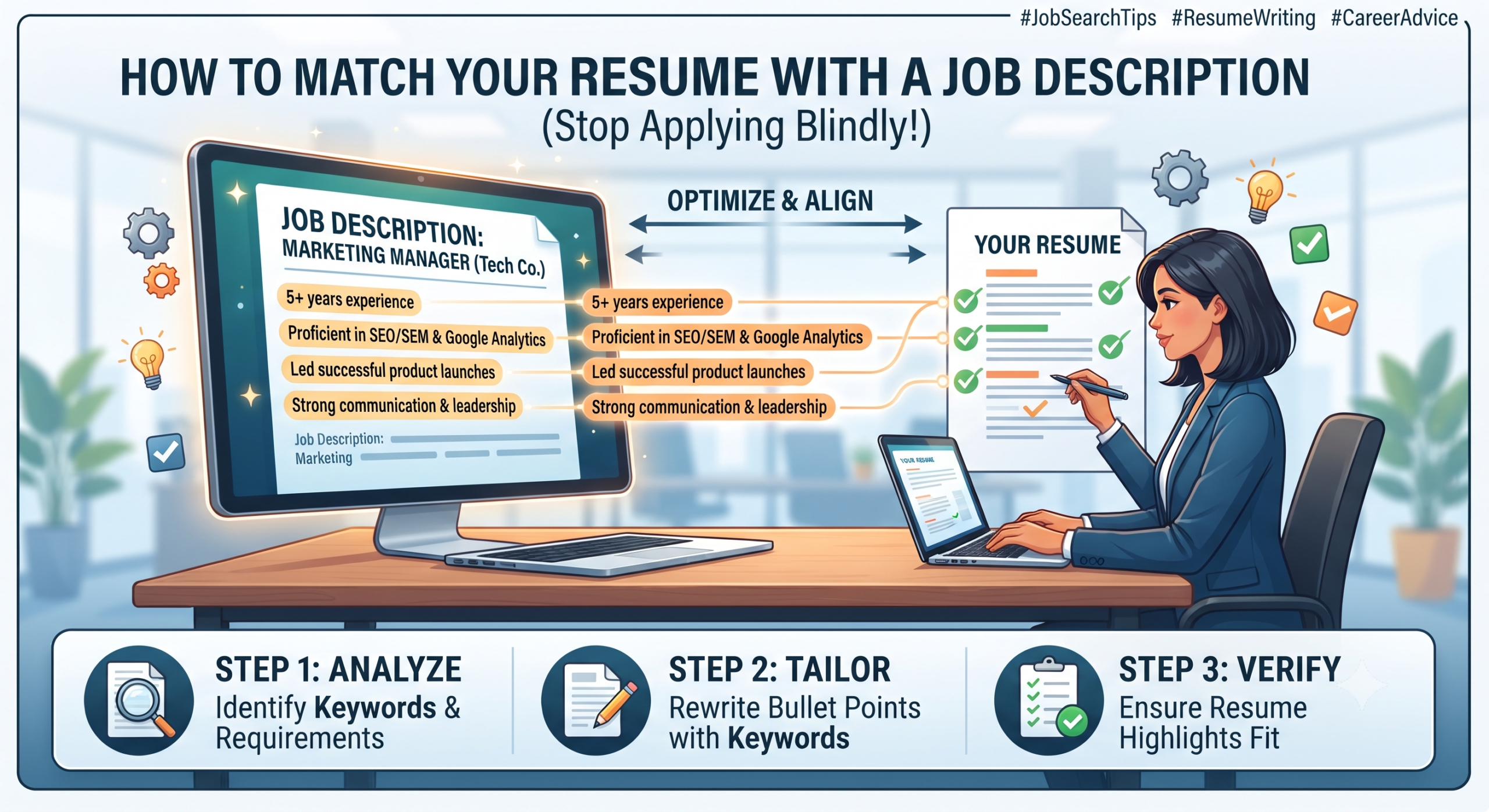
Alright, let’s cut through the noise, because frankly, most advice out there on resumes is fluff. You’ve been told to “tailor your resume,” right? Everyone says it. But what does that actually mean beyond just changing the job title and truly matching your resume with a job description? Here’s the real talk: if you’re still blasting out the same generic resume to every open position, you’re not just wasting your time, you’re practically volunteering your application for the digital shredder.
And honestly, you’re leaving 75% of opportunities on the table. Think that’s overkill? Nope.
How to Match Your Resume With a Job Description (Stop Applying Blindly!)
Look, I’ve seen enough campaigns bomb because they went for a “spray and pray” approach. My growth marketing brain sees your job search through the same lens: it’s a series of micro-conversions. And the first, biggest hurdle? Getting past the robots and into a human’s inbox.
The Resume Black Hole is Real: Why Your Generic Resume Fails (ATS Demystified)
Here’s the thing: most of your applications don’t even make it past a computer. Seriously. Applicant Tracking Systems – ATS, for short – are software designed to screen resumes before a recruiter ever lays eyes on them. It’s a digital gatekeeper, and it’s ruthless.
ATS software scans your resume for keywords, phrases, and formatting. It’s like Google for hiring managers, trying to find the most relevant “search result” among hundreds, sometimes thousands, of applications. If your resume doesn’t use the exact language from the job description, it won’t rank high. Period. Up to 75% of job applications are rejected by these systems before a human ever sees them, primarily due to lack of keyword alignment or formatting issues. That’s a huge problem if you’re just throwing a general resume at the wall, hoping something sticks. You’re not even playing the right game.
Beyond the Bots: Understanding Recruiter Psychology
Okay, so you beat the bot. Congrats! Now you’re facing a human. But don’t pop the champagne just yet. The next hurdle is even tougher: attention span. Recruiters aren’t lingering over your life story. Nope, they’re probably juggling a dozen other openings, a mountain of emails, and an endless list of meetings.
Recruiters spend an average of just 6-7 seconds scanning a resume. Yeah, you heard that right. Six. To. Seven. Seconds. Your resume isn’t getting read; it’s getting scanned. They’re looking for instant signals: relevance, key skills, quantifiable achievements. If they can’t find what they need in those precious seconds, you’re out. It’s brutal, but it’s the reality of the game. Your resume needs to hit them right in the face with exactly what they’re looking for.
The Growth Marketer’s Secret Weapon: Tailoring Your Message
Think about how top brands do growth marketing. Do you see HubSpot sending the same generic message to every single person on their email list? Or Grammarly running one single ad creative for all its users? No way. They intensely segment their audience, understand their specific pain points, and then tailor content, CTAs, and ad copy to speak directly to that individual. They do it because personalized messages convert like crazy. Why should your job search be any different?
- HubSpot’s Segmented Content Strategy is Your Resume Goal: HubSpot nails hyper-personalization for different user journeys. Someone looking for “SaaS lead generation” gets a totally different CTA than someone seeking a “Beginner’s Guide to Social Media.” Each blog post and its CTAs are “tailored” to a “job description”—the user’s specific problem. You wouldn’t send a generic resume to every job, and HubSpot doesn’t show generic CTAs to every visitor. This focused approach drastically boosts conversions by making every interaction incredibly relevant. This level of intentionality is exactly what you need for your resume.
- Grammarly’s Hyper-Targeted Ads Show the Power of Specificity: Grammarly churns out hundreds of ad creatives. One ad might target students with “Ace Your Academic Writing!” while another speaks to pros: “Polish Your Professional Communications.” Every ad is a mini “resume” crafted for a distinct “job description”—a specific demographic and their pain point. By micro-targeting, they improve ad spend and skyrocket click-throughs. It proves that a message tailored to a specific need will always outperform a generic one. Always.
- Apollo.io for Personalized Outreach? That’s Your Resume Mindset: Growth teams use tools like Apollo.io to pinpoint specific leads (e.g., a “Head of Marketing at Series B SaaS”). Then, their outreach messages scream personalization, referencing recent company news or specific job responsibilities. This personal touch is your resume. The goal is to immediately show the recipient that you understand their specific context and challenges. This meticulous tailoring supercharges reply rates over generic cold outreach. It’s the marketing equivalent of perfectly matching your resume with a job description. This bypasses the “generic pile” and shoots you straight to “human review.”
The lesson? Personalization isn’t just a marketing buzzword; it’s the absolute game changer for your job hunt.
From Generic to Game Changer: Your Step-by-Step Guide to Matching Your Resume With a Job Description
Okay, you get it. Blasting out resumes blindly is suicide. So, let’s talk about how to actually make your resume match—not just vaguely resemble—the job description.
Step 1: Dissect the Job Description Like a Detective
Before you even think about opening your resume, grab the job description. Print it out, copy-paste it into a doc, whatever. Now, underline, highlight, circle everything.
- Keywords: What words appear repeatedly? What are the core skills, software, methodologies, and responsibilities mentioned? These are your primary keyword targets for the ATS.
- Action Verbs: Look for the verbs they use to describe duties: “managed,” “developed,” “analyzed,” “set uped,” “led.” Use these in your resume.
- Required vs. Preferred: Pay close attention to what’s non-negotiable versus what’s a bonus. Make sure your resume hits every single “required” point.
- Company Values & Mission: Sometimes the JD hints at company culture. Can you inject a subtle nod to “innovation” or “collaboration” if it’s a core theme?
This isn’t skimming; it’s a deep, tactical analysis.
Step 2: Keyword Power Play – Improving for ATS
Now, with your “hit list” of keywords, go through your resume. This isn’t about keyword stuffing – that looks spammy to both bots and humans. It’s about integration.
- Skills Section: Make sure every technical skill, software proficiency, and relevant certification from the JD is explicitly listed here. If they say “CRM,” don’t just put “Salesforce” if that’s implied. Put “CRM (Salesforce).”
- Experience Section: Weave those keywords naturally into your bullet points. If the JD stresses “cross-functional team leadership,” don’t just say “led projects.” Say, “Led cross-functional teams of 5-7 to deliver X project, resulting in Y.”
- Context is Key: Sometimes the JD uses a specific phrase, like “end-to-end project management.” If your experience covers that, use that exact phrase.
Remember, the ATS is looking for literal matches. So, spell out acronyms the first time you use them (e.g., “Search Engine Improvement (SEO)”). It helps.
Step 3: Show, Don’t Just Tell – Quantify Your Achievements
This is where you make those 6-7 seconds count for the human recruiter. Quantify everything possible. Did you “increase sales”? By how much? “Managed a team”? How big? “Improved efficiency”? By what percentage, leading to what outcome?
- Example (Bad): “Responsible for marketing campaigns.”
- Example (Better): “Developed and executed multi-channel marketing campaigns, increasing lead generation by 30% year-over-year and achieving a 15% improvement in conversion rates.”
Numbers are universal. They scream impact. They make your claims tangible. They cut through the noise.
Step 4: Craft a Compelling Summary/Objective
Your resume summary or objective (if you’re just starting out) is your elevator pitch—your chance to immediately hook the reader. Tailor this hard. It should explicitly state your most relevant skills and achievements as they pertain to this specific role and company. Don’t just list your career goal; show how your goal aligns with their needs.
Highlight 2-3 of your strongest, most relevant qualifications that directly answer what they’re looking for in the JD. Make it a micro-version of your best case study.
AI is Your New Co-Pilot: Smartly Matching Your Resume With a Job Description (Hello, AICreatify!)
Honestly, manually doing all this for every single application? It’s a grind. A necessary grind, sure, but what if you could have an intelligent assistant making it easier, faster, and way more effective? That’s where AI tools like AICreatify come in. This isn’t about replacing you; it’s about giving you a superpower.
We know job seekers using AI tools for resume improvement report a 30% higher callback rate compared to those who don’t. That’s a serious edge.
Imagine: you upload your resume and the job description to AICreatify. The tool then analyzes them both, highlights the gaps in your resume, and suggests how you can better align your wording with the job description. It’ll point out critical keywords you’ve missed, or suggest stronger action verbs that resonate with the JD’s language. It’s like having a growth marketing analyst scrutinize your message for optimal conversion every single time. It literally takes the guesswork out of the equation and gives you a relevance score—so you know exactly how well you’re matched before you even apply.
Want to see this in action for your LinkedIn game? Check out AICreatify’s LinkedIn Hooks for Founders for viral post templates – it’s that level of tailored impact we’re talking about.
You feed it the JD, your raw resume, and boom – intelligent suggestions pop up, telling you what needs tightening, what to add, and where to swap in stronger, more targeted language. It makes achieving a 90%+ relevance score a real possibility, rather than just a pipe dream. This kind of precision is a massive time-saver and a serious competitive advantage in a crowded market.
Don’t Forget the Details: Formatting & Proofreading
All that hard work can fall apart if your resume looks like a mess or has typos.
Real talk for a second.
- Clean Formatting: Keep it simple. Use standard fonts (Arial, Calibri, Times New Roman are safe bets), clear headings, and enough white space. Avoid complex graphics, tables, or unusual characters, which can confuse ATS.
- Proofread Relentlessly: Read it forwards, then backwards. Get a friend to read it. Use a grammar checker. An obvious typo screams “lack of attention to detail,” and that’s a red flag no amount of tailoring can fix.
And for keeping your other digital communication super sharp – like those crucial follow-up emails – you might find AICreatify’s Instagram Caption Generator (yes, even for professional uses!) and Hashtag Generator handy. It’s about precision everywhere.
Stick with me here.
Frequently Asked Questions About Resume Matching
How much should I customize my resume for each job?
You should customize your resume as much as it takes to achieve an 80%+ match with the job description. This could involve minor tweaks or a complete overhaul of your bullet points and summary, treating it like a conversion rate improvement task for higher chances.
Can AI tools really help me match my resume?
Absolutely, yes. AI tools are powerful accelerators that identify missing keywords and suggest impactful phrasing to better align your experience with the job description. This significantly reduces manual effort and boosts your confidence in hitting the mark.
What are common mistakes when trying to match a resume?
Common mistakes include keyword stuffing, focusing only on skills instead of quantifiable achievements, using generic language, and poor formatting that confuses ATS. Failing to proofread is also a significant and detrimental error.
Is it okay to use keywords multiple times?
Yes, using relevant keywords multiple times is natural and helps ATS identify density and relevance. The key is natural integration, ensuring it makes sense in context and doesn’t sound like keyword stuffing.
Look, applying for jobs is tough. It feels like you’re yelling into a void sometimes. But by understanding how ATS works and what recruiters are really looking for – which is basically just strong, hyper-personalized relevance – you stop applying blindly. You start applying strategically. You transform your resume from a general-purpose document into a targeted marketing piece, designed specifically to convert. So, go dissect those job descriptions, unleash your inner growth marketer, and get that interview. You got this.
About Author
Susha Kanaujia
Product Manager and AI enthusiast with 16+ years of experience in technology and digital products.
Check your resume against the job, free
Paste your resume and a job description to get an ATS match score, the keywords you're missing and a fix list.
Check My Resume — Free🚀 Enjoying AICreatify?
We'd love your support on Product Hunt. ❤️ Upvote us and share your feedback.