
How to Use Keywords Effectively in 2026

sushakanaujia
Author
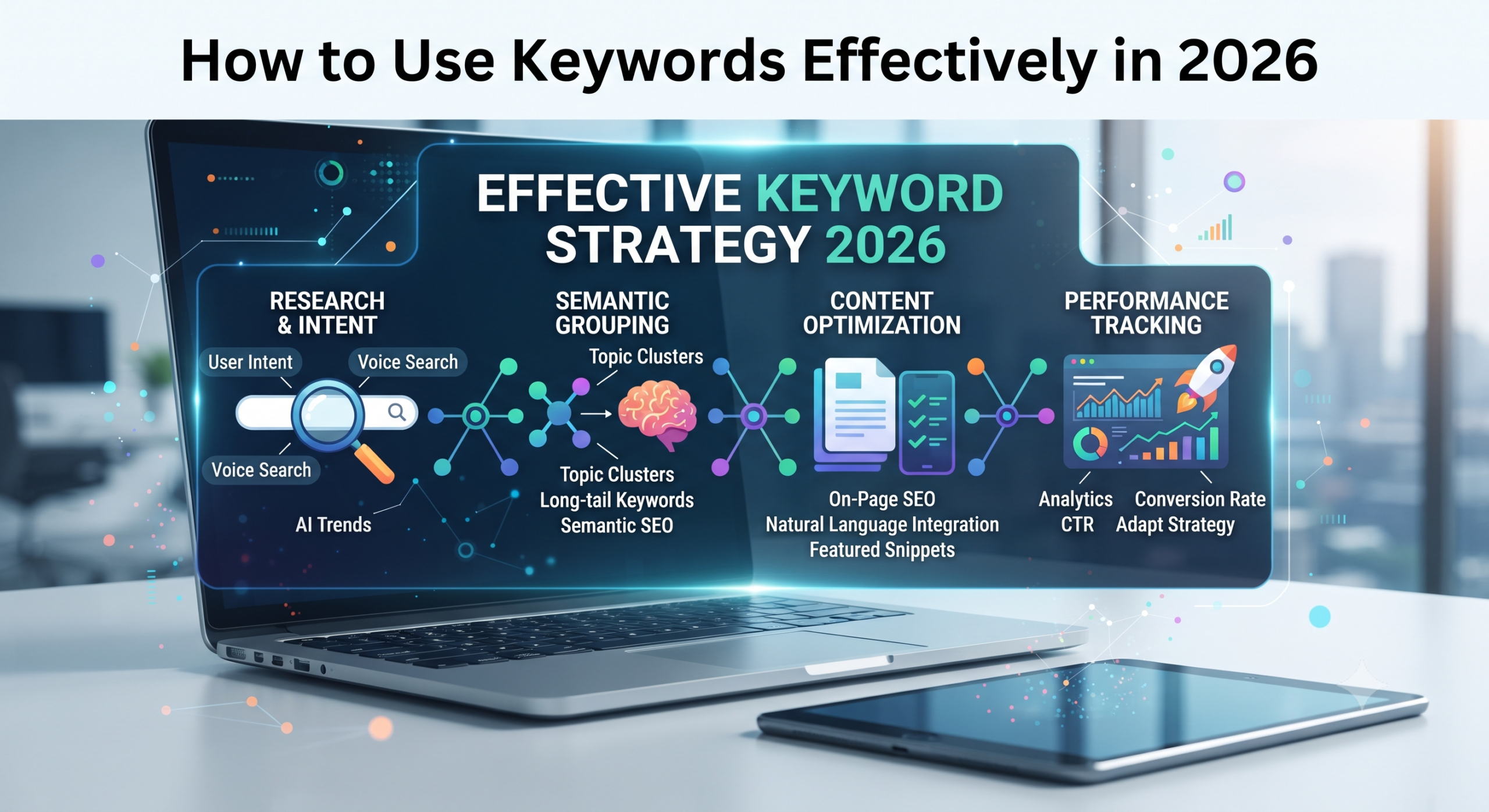
Heard the whispers? Some LinkedIn guru claiming “keywords are dead”? Nah. That’s just someone stuck in 2018. Keywords aren’t dead; they’re simply smarter now. And so is Google. If you’re still thinking about keyword density like it’s 2005, you’re actively hurting your chances. So, how to use keywords effectively in 2026? It means figuring out what people *really* want, weaving natural language through your content, and getting good at semantic optimization. It’s not about stuffing words; it’s about arranging them to create the best, most complete answer for Google’s AI and your human readers, plain and simple.
Key Takeaways
- Intent Reigns Supreme: Forget keywords if you don’t know *why* someone’s searching. Nail the user’s intent first.
- Orchestrate, Don’t Stuff: Think of your content as a symphony. Every keyword has its role, from the main theme to the subtle harmonies.
- AI is Your Co-pilot: Use AI tools to find semantic gaps, generate variations, and ensure natural integration, not to brute-force keywords.
- Future-Proof for AI Search: Structure your content to be easily digestible by generative AI and cater to multimodal queries (voice, image).
- Topical Authority Wins: Go beyond single keywords. Become the go-to resource for an entire topic.
Table of Contents
- Understanding Search Intent and Keyword Types
- Your Step-by-Step Keyword Usage Workflow
- Mastering On-Page Keyword Placement Best Practices
- Avoiding Common Keyword Mistakes and Penalties
- Beyond Density: Semantic Optimization and LSI Keywords
- Real-World Example: Optimizing a Blog Post with Keywords
- Future-Proofing Your Keyword Strategy for Evolving Search
- Frequently Asked Questions About Keyword Use
Understanding Search Intent and Keyword Types
Google doesn’t just read words anymore. It understands. It’s smart enough to know if you’re looking for an apple (the fruit) or Apple (the company). This isn’t magic; it’s intent.
What Google Really Wants: Satisfying User Intent
In 2026, Google’s algorithms are focused on intent more than ever. It’s not about matching your words; it’s about giving the user what they really want. Are they trying to buy something, learn how to do something, or just looking for a website? If your content doesn’t line up with what they *actually* want, you’re sunk before you even start. Get this wrong, and nothing else matters.
Primary, Secondary, and Long-Tail Keywords Explained
Think of these like members of a band, each with a different role:
- Primary Keyword (Your Lead Singer): This is the main thing you want your content to rank for. It’s the core of what people are searching. For this article, it’s “how to use keywords.”
- Secondary Keywords (Your Backup Vocals): These are closely related ideas that support your primary keyword. They often become your main section headings (H2s). Think “how to use keywords in blog posts” or “best practices for keyword placement.” They add depth and cover related questions.
- Long-Tail Keywords (The Rhythm Section): These are longer, super specific phrases (usually three or more words). They might have lower search volume, but the people searching them know exactly what they want. They convert better and cover niche aspects. An example would be “how to optimize content with keywords for generative AI search.”
The Role of LSI Keywords (Latent Semantic Indexing)
Okay, so “LSI keywords” is a bit of an old-school term. In 2026, it’s less about finding a specific list of “LSI keywords” and more about making sure your content is *semantically rich*. This means you’re using all the words and phrases an expert would naturally use when talking about your topic. If you’re talking about dogs, you’d mention breeds, leashes, walks, vets, and maybe even chasing squirrels. Those related terms help Google understand you’re covering the topic thoroughly, not just repeating the same word. It builds context.
Your Step-by-Step Keyword Usage Workflow
Here’s the playbook I follow to get results:
Step 1: Foundational Keyword Research (Beyond the Obvious)
Don’t just plug one word into a tool and call it a day. Dig deep.
- Start with your primary idea: Use tools like SEMrush, Ahrefs, or even Google Keyword Planner. Get some initial data.
- Uncover Search Intent: This is crucial. Google your primary keyword. What shows up in the top 10 results? Are they “how-to” guides, product reviews, news articles? That tells you what intent Google believes fits best. Match that intent.
- Mine for Secondary & Long-Tail:
- Look at Google’s “People Also Ask” (PAA) boxes. Seriously, these are gold. They’re direct questions users are asking. Instant H2 ideas.
- Scroll to the “Related Searches” at the bottom of the SERP. More gold.
- Check out your competitors. What are they ranking for?
- Use AI. Tools like AICreatify can help you uncover topical clusters and semantic ideas you might miss with manual research.
Step 2: Matching Keywords to Content Structure (The “Orchestration” Framework)
This is where you stop thinking about individual keywords and start thinking about your content as a whole, harmonized piece.
- Primary Keyword: The Conductor (H1 & Core Message): Your primary keyword goes in your H1. The intro should immediately address the main intent of that keyword. It’s the main theme, setting the stage.
- Secondary Keywords: Section Leads (H2s & Subheadings): Your secondary keywords become your main section headings (H2s). This ensures you’re answering all the related questions and covering the topic thoroughly. If your primary is “how to use keywords,” then “how to use keywords in blog posts” and “best practices for keyword placement” become your H2s.
- Semantic Terms & Long-Tails: The Melody (Body & Supporting Details): Weave all those related terms and specific long-tail phrases naturally into your body text. These fill out the details and catch those highly specific searches.
- Think of it like building a house. The primary keyword is the foundation. The secondary keywords are the rooms. The semantic terms are the furniture, decor, and everything that makes it a livable space.
Step 3: Crafting Compelling Titles and Meta Descriptions
These are your storefront windows. Make them count.
- Title Tag (the blue clickable headline on Google):
- Put your primary keyword as close to the front as possible.
- Make it attractive. Something that screams, “Click me!”
- Keep it around 50-60 characters so it doesn’t get cut off.
- Example:
How to Use Keywords Correctly in 2026: Your Definitive Guide
- Meta Description (the small text under the title):
- Include your primary keyword and maybe a secondary one too.
- Write a short, persuasive summary—around 150-160 characters. Tell them what problem you solve.
- Example:
Unlock smarter SEO. Learn how to use keywords effectively in 2026 with AI and semantic strategies for real organic ranking. Get the playbook.
Step 4: Seamlessly Integrating Keywords into Your Content Body
This is where the rubber meets the road. It has to feel *natural*.
- Introduction: Get that primary keyword in the first 100-150 words. Set the expectation for what you’re covering.
- Body Paragraphs:
- Natural Flow is King: If it sounds forced, rewrite it. Read it aloud. Does it sound like a robot wrote it? Fix it.
- Vary Your Phrasing: Don’t just copy-paste the exact keyword over and over. Use synonyms, rephrase, find related ideas. Instead of “keyword density” every time, try “keyword distribution” or “topical relevance.”
- AI-Assisted Natural Language Integration (This is where AICreatify shines): This isn’t just theory for me; it’s how I run things daily. I use tools like AICreatify to help me get this right without sounding like a chatbot.
I feed my draft and target keywords into AICreatify. It analyzes for keyword saturation, semantic coverage, and readability. It’ll suggest places where I could naturally add a secondary or long-tail keyword I missed, or offer synonyms to make my language less repetitive. It’s like having an editor who’s also an SEO expert.
- Conclusion: Wrap it up by reiterating your main point and the primary keyword. Give a clear call to action, if applicable.
Step 5: Optimizing for Multimodal and Generative AI Search (Future-Proofing)
This is 2026. If you’re not thinking about how AI *reads* your content, you’re missing a trick.
- Structured Data (Schema Markup): Use schema.org markup (like Article, HowTo, FAQPage) to literally tell Google what your content is about. This is like putting a label on your food—makes it much easier for AI to understand and summarize.
- Clear, Concise Language: Generative AI loves easy-to-digest info. Short paragraphs, bullet points, numbered lists, clear topic sentences—these are your friends.
- Answer Implicit Questions: Think beyond your direct keywords. What would someone ask *after* reading your article? What related questions would an AI try to answer? Cover those.
- Transcripts for Multimedia: If you have videos or audio, always include full transcripts and captions. Keywords in these help search engines understand the content, which is key for multimodal search (when people search with images or voice).
Mastering On-Page Keyword Placement Best Practices
Beyond what’s already covered, here are the non-negotiables:
The Power of Your H1 and Subheadings (H2s, H3s)
- H1: Your main heading *must* contain your primary keyword. It’s the strongest signal to Google about your page’s topic.
- H2s: These are for your secondary keywords or long-tail variations. They break up your content, make it scannable, and signal important sub-topics.
- H3s (and below): Use these for more detailed points within your H2 sections, naturally integrating semantic terms.
Your heading structure is Google’s mini-outline of your page. Structure it logically for humans first, and the SEO will follow. It’s not rocket science—it’s just good writing.
Keywords in the Introduction and Conclusion
- Introduction: Get that primary keyword in the first 100-150 words. Google needs to know immediately what the page is about.
- Conclusion: Reiterate the primary keyword or a close variation. Summarize the key takeaways, hammering home your core message.
Strategic Use in Body Paragraphs (No Stuffing Allowed!)
- Distribute your primary, secondary, and semantic keywords naturally. Remember the ‘orchestration’ idea: don’t just dump all the percussion in one spot.
- Seriously, read it aloud. If it sounds forced, change it. Google prioritizes user experience above all else.
- Here’s a hot take: Forget the old “2-3% keyword density” rules. That’s so 2010. In 2026, it’s about *topical breadth and depth*. Focus on writing an incredibly thorough, natural, valuable piece of content that covers the subject completely. If you do that, Google will understand its relevance. Trying to hit a specific percentage usually leads to terrible writing and then—well, terrible rankings.
Image Alt Text and Internal Linking Opportunities
- Image Alt Text: Describe your images using relevant keywords, but only when it makes sense. This helps with accessibility and gives context to search engines. For example,
alt="step-by-step keyword research workflow diagram"is perfect. - Internal Linking: When you link to other relevant articles on your site, use descriptive anchor text that includes keywords related to *that destination page’s topic*. This builds authority and helps distribute “link juice” across your site. For instance, if I’m talking about optimizing your LinkedIn profile, I might link to our LinkedIn Profile Keywords Overhaul guide with an anchor like “LinkedIn profile keywords.”
Avoiding Common Keyword Mistakes and Penalties
Believe me, I’ve seen clients make these mistakes. Don’t be one of them.
The Dangers of Keyword Stuffing (Yes, It’s Still a Thing!)
- If you repeat keywords excessively (e.g., “Our awesome keyword tool is the best keyword tool for finding keywords, so use our keyword tool to find keywords”), it makes your content unreadable. Google sees this as a manipulative tactic and will smack you with a ranking penalty. Hard.
- Mistake: Thinking more keywords equals better SEO. It absolutely does not.
Ignoring Search Intent: Why It Kills Rankings
- If someone searches “best running shoes” (they want to buy) and your article is “the history of athletic footwear” (they want to learn), they’ll bounce immediately. Google tracks user engagement—or lack thereof—and will demote you. You promised a steak and delivered a history lecture.
- Mistake: Creating content that doesn’t align with what the searcher *actually* wants.
Over-Optimization vs. Natural Language
- Too many people try so hard to be “SEO-friendly” they end up writing like robots. Google loves user experience. If your content sounds artificial, users will leave, and your rankings will suffer.
- Mistake: Focusing purely on technical SEO boxes without remembering you’re writing for actual human beings.
Misunderstanding Keyword Density in 2026
- Still fixating on a specific keyword density percentage? Stop. Google’s algorithms are way too advanced for that. They understand context, synonyms, and related ideas. Trying to force a density will almost always lead to keyword stuffing.
- Mistake: Believing a specific number is a ranking factor instead of focusing on complete, natural topical coverage.
Beyond Density: Semantic Optimization and LSI Keywords
Let’s get real about what builds lasting authority.
Building Topical Authority with Related Terms
Instead of just chasing individual keywords, aim to become the definitive resource for an *entire topic*. This means covering all the related sub-topics and questions, using a rich, natural vocabulary. This isn’t just about keywords; it’s about demonstrating deep expertise to Google. Think big, act complete.
How Google Understands Context, Not Just Keywords
Google’s BERT and MUM updates changed the game. It understands the relationships between words, the nuances of language, and the overall context of a page. This means using a variety of semantically related terms is far more effective than just repeating one keyword. It understands the *topic*, not just the individual words you’re saying.
Using AI Tools for Semantic Enrichment
This is another area where AI is a secret weapon.
AICreatify doesn’t just check for keywords. It looks at your content’s entire semantic field against a massive knowledge graph related to your topic. It’ll point out concepts you might have missed or areas where you could naturally expand to show deeper understanding. It helps you enrich your content so Google says, “Ah, this person *really* knows their stuff.”
Real-World Example: Optimizing a Blog Post with Keywords
Let’s talk about what actually works.
Case Study: Taking a Draft from Good to Great with Smart Keyword Use
Take HubSpot. They’re masters of something called “Keyword Orchestration” with their pillar page strategy. For a broad keyword like “inbound marketing,” they build a massive, complete pillar page that uses that keyword in the H1 and key H2s. Then, they create tons of smaller, super-focused blog posts (cluster content) that each target secondary or long-tail keywords (e.g., “how to create buyer personas,” “inbound marketing strategy examples”). These smaller posts link back to the pillar, and the pillar links out to them. This creates a whole ecosystem of content that makes them the authority for “inbound marketing” and all its facets. It’s a cohesive content network, not just random articles.
Or look at Ahrefs’ blog content for SEO tools. They rank for highly competitive terms because their articles are ridiculously in-depth and user-focused. For “keyword research,” their content doesn’t just use the term; it covers *everything*: “how to find keywords,” “keyword research tools,” “long tail keyword examples,” “keyword difficulty,” and actual examples. They use a massive vocabulary of related terms, ensuring they answer every possible question. Google rewards that kind of valuable content.
Before & After: How Strategic Keyword Orchestration Improves Clarity and Ranking Potential
Imagine a service page from years ago.
- Before (Simple Keyword Placement): A page titled “Our Services” with a few scattered mentions of “SEO services” and “digital marketing agency.” Technically, the keywords are there, but it’s unstructured and vague. It reads like an afterthought.
- After (Keyword Orchestration):
- H1: “Strategic SEO & Digital Marketing Services for Measurable Growth” (Primary: “SEO & Digital Marketing Services”)
- H2s: “Our Tailored Organic Search Strategies,” “Content Marketing That Drives Leads,” “Paid Media Management for Maximum ROI” (Secondary keywords for specific service areas).
- Body: Within each section, uses long-tail and semantic terms like “local SEO optimization,” “technical SEO audit,” “high-converting blog post creation,” “email marketing campaigns,” “Google Ads expertise,” etc.
- Alt Text: Images describing each service get alt text like
alt="expert SEO strategy session". - Internal Links: The page links to case studies about specific services, using anchor text like “view our content scaling successes.”
- Outcome: The “After” page is clear, provides immense value, is easy for users to navigate, and tells Google exactly what it’s about. It establishes authority and relevance, which means better rankings.
Future-Proofing Your Keyword Strategy for Evolving Search
The search world changes fast. Staying ahead means adapting.
Adapting to Generative AI in Search Results
Google’s SGE-like features are becoming more common. This means AI-generated summaries and answers will often show up right there on the search results page. Your content needs to be structured so these AIs can easily read, understand, and summarize it accurately.
- Strategy: Write like you’re teaching. Use direct answers to questions (FAQ format is great), clear headings, bulleted lists, and ensure your facts are rock solid. You want your content to be a trusted “source of truth” not just for humans, but for AI too.
The Importance of Entity-Based SEO
Google is moving past just keywords. It’s understanding “entities” (real-world objects, concepts, people, places). When you mention “New York City,” Google knows it’s the metropolis, not just three random words.
- Strategy: Be precise. Use proper nouns. Link to authoritative sources when you talk about specific entities. Make sure your content fully explains and contextualizes the entities you mention. This builds a richer, interconnected web of knowledge, something Google loves.
Voice Search and Conversational Keywords
People talk to their devices. Voice search queries are usually longer, more conversational, and often phrased as questions (e.g., “Hey Google, how do I use keywords effectively in a blog post?”).
- Strategy: Incorporate natural language questions and answers into your content. Use full sentences and conversational phrasing. Optimize for those longer, question-based long-tail keywords. If your primary keyword is “best keyword tools,” also include sections that answer questions like “What are the best keyword research tools for beginners?” within your content. My Hashtag Generator can even help you brainstorm natural phrases.
Frequently Asked Questions About Keyword Use
How many keywords should I use in an article in 2026?
Don’t fixate on a number. Focus on thorough topic coverage. Naturally integrate your primary keyword, perhaps 3-5 secondary keywords (often your H2s), and a dozen or more related semantic terms and long-tail variations throughout a complete article. The goal is natural language and serving your audience, not a count.
What is the most effective way to use keywords for SEO?
The most effective way is through “Keyword Orchestration”: Identify user intent first, strategically place your primary keyword in your title and H1, use secondary keywords in subheadings, and naturally weave semantic terms throughout the body. This creates a complete, authoritative, and user-friendly resource that genuinely answers the search query.
Can using too many keywords hurt my SEO ranking?
Yes, absolutely. This is “keyword stuffing,” a black-hat tactic that Google actively penalizes. It ruins user experience and signals manipulation, leading to lower rankings or even removal from the search index. Always prioritize natural language and value for the reader.
What are LSI keywords and how do I use them?
LSI keywords are semantically related terms that help search engines understand your content’s context and depth. You use them by naturally incorporating a rich vocabulary of synonyms, related concepts, and specific details a subject matter expert would use. It’s about ensuring your content covers the full topic holistically.
How do I choose the right keywords for my content?
Start by really understanding your target audience and their search intent. Use keyword research tools to find relevant primary keywords with good search volume. Then, expand to secondary and long-tail keywords by looking at “People Also Ask,” related searches, and competitor content. Always pick keywords that perfectly align with your content’s purpose and your audience’s needs.
About Author
Susha Kanaujia
Product Manager and AI enthusiast with 16+ years of experience in technology and digital products.
Is Your LinkedIn Profile Holding You Back?
Get an instant AI audit of your headline, About section, and keywords. Discover exactly what recruiters see and get 1-click Before & After rewrites to rank higher in searches.
+42% Recruiter Views predicted if you fix 3 keyword gaps.
🚀 Enjoying AICreatify?
We'd love your support on Product Hunt. ❤️ Upvote us and share your feedback.