Why Your LinkedIn Posts Get No Engagement (And How to Fix It)

sushakanaujia
Author
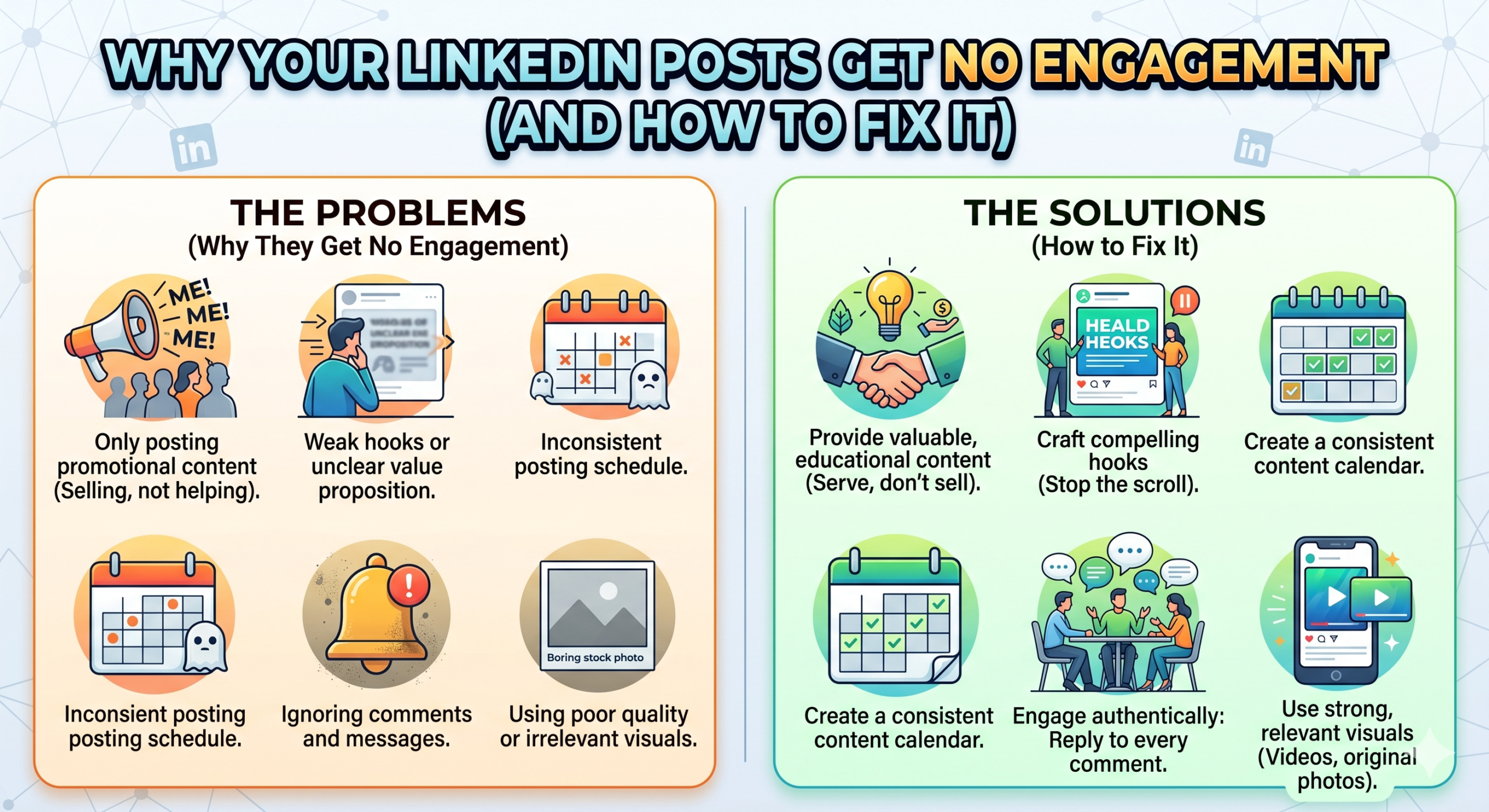
Alright, let’s talk LinkedIn. Because if there’s one thing that gets under my skin, it’s seeing smart, hard-working professionals pump out decent content on LinkedIn only for it to disappear into the digital ether. Crickets. Zero meaningful engagement. No leads. Just… nothing.
You know the drill. You spend an hour crafting what you think is a brilliant post, maybe a mini-case study or a thoughtful take on an industry trend. You hit ‘post,’ then refresh every five minutes like a hawk. An hour passes, then two. You get a few likes from your aunt and a former colleague, but that’s it. You’re left wondering if LinkedIn hates you, if your content just sucks, or if you’re just shouting into a digital void.
Sound familiar? Good. Because honestly, it’s not you, and it’s probably not even your content in isolation. It’s usually a cocktail of misunderstanding the platform, the algorithm‘s actual priorities, and what “engagement” even means in the first place. This isn’t about some magic “hack” or just throwing more stuff out there. This is about diagnosing the actual problem and pulling the right levers for real business impact.
We’re going to fix this. I’ll walk you through why your LinkedIn posts get no engagement – the real reasons, the ones beyond the surface-level tips everyone else offers. Then, we’ll equip you with actionable, battle-tested strategies to not just get noticed, but to generate actual leads and establish yourself as a thought leader. It’s time to stop guessing and start growing.
The Deceptive Truth: Why Your “Engagement” Isn’t What You Think It’s
Look, we’re all guilty of chasing the shiny numbers. You see a post with 500 likes and think, “Damn, I need that!” But here’s the thing: those likes often mean squat with your bottom line.
The Pitfall of Vanity Metrics: Likes vs. Meaningful Interactions
Let’s just be honest: likes are dopamine hits, not sales leads. I’ve seen posts with thousands of likes that generate exactly zero qualified conversations. On the flip side, I’ve seen posts with 30 likes but 5 deeply thoughtful comments from target prospects that led to multiple 5-figure deals. See the difference?
Your engagement hierarchy should go like this:
- Likes: Bare minimum. Good for signalling initial interest, but easily gamed or just from your buddies.
- Shares: Better. Someone thinks it’s valuable enough for their network. But still, the “why” matters. Is it just a re-share with no context?
- Comments: Gold. This is where conversations start. It shows deeper interest, critical thinking, and a willingness to engage publicly. The more nuanced and conversational the comment, the better.
- DMs/Profile Views from Target Audience: Unicorn-level awesome. This means your content got someone to move from passive consumption to active interest in you or your services.
Data Insight: Industry benchmarks suggest average LinkedIn engagement rates range from 0.5% to 2%. That sounds low, right? But here’s the kicker: a “good” engagement rate for a personal brand laser-focused on lead generation often exceeds 3-5%—and we’re talking about comments and DMs from qualified prospects, not just random pings. Think about it: a single, high-quality comment from a target decision-maker can be 100x more valuable than 50 likes from peers. Stop chasing fluff.
LinkedIn’s algorithm actually weighs different interactions for distribution. A comment tells the algorithm that your content is sparking discussion, driving dwell time, and making people stick around. A like? It’s a quick tap. The more substantive interaction you get, the more LinkedIn’s algorithm thinks, “Hmm, people are *really* into this. Let’s show it to more folks.”
Identifying Your True Engagement Score: Beyond the Numbers
So, how do you measure what actually matters? You connect post performance to bigger-picture outcomes. Are those posts leading to more profile views from people in your target industry? Are you getting more connection requests from qualified professionals you actually want in your network? Most importantly, are you sparking direct outreach and DMs that lead to discovery calls or sales conversations?
Set some real KPIs. Forget “I want more likes.” Instead, aim for “I want X qualified prospect DMs per month.” Or “I want Y discovery calls booked directly from LinkedIn leads.” These are the metrics that move the needle. Period.
Cracking the Code: Common Reasons Your LinkedIn Posts Fall Flat (And How to Debug Them)
Alright, let’s get into the nitty-gritty. Why’s your perfectly good content just… flopping? More often than not, it comes down to a few key areas that are surprisingly easy to fix.
You’re Not Speaking to Your Ideal Audience (Audience Targeting Miss)
This is the big one, honestly. Many people post whatever content they think is generically “good,” or worse, what their company wants them to post. But who are you trying to reach, really?
You need to get ruthless about defining your niche and your ideal prospect persona. For LinkedIn, this isn’t just demographics; it’s pain points, aspirations, industry jargon they use, the conferences they attend (even virtually), and the problems they’re actively trying to solve *right now*. Are they SaaS founders buried in churn? Marketing VPs trying to scale their teams? Consultants looking to refine their service offering?
Until you’re surgically tailoring your content to their specific anxieties, desires, and the language they use, you’re just broadcasting into the ether. You’ve got to become their solution, their confidante, their trusted expert. If your content speaks to everyone, it speaks to no one.
Seriously, if you’re struggling to hit the right note, tools like AICreatify’s LinkedIn Hooks Generator can be a game-changer for brainstorming angles that really speak to your niche and grab attention.
The Algorithmic Blinders: Why Your Content Isn’t Seen
You’re not just posting to your connections; you’re posting to the algorithm, and it’s a fickle beast. LinkedIn’s algorithm has shifted, big time. It heavily prefers native content – stuff created on LinkedIn, not just linked to from outside. It loves dwell time (how long people spend engaging with your content on the platform) and comment velocity (how quickly your post gets comments, especially substantive ones, right after you publish).
Data Insight: Forget sharing YouTube links. Native LinkedIn video typically receives 3x higher engagement because people watch it on the platform. Document posts (carousels, PDFs) often drive superior dwell time and ‘saves,’ which the algorithm interprets as strong interest signals. And the ‘first 60 minutes’ rule? It’s critical. Posts that get high comment velocity and diverse engagement (we’re talking comments, shares, not just likes) within that first hour are exponentially more likely to be pushed to a broader audience. That first hour is your make-or-break moment.
So if you’re just dropping a link to your latest blog post, LinkedIn sees that as sending people *away* from its platform. Why would it reward that? It won’t.
Content Catastrophes: Generic, Salesy, or Low-Value Posts
Yeah, your content might be fine, but is it *exceptional*? Are you just recycling old blog posts? Are you always pushing your product or service without giving anything truly valuable away first? Because generic, salesy, or low-value content is a fast track to being ignored.
You need a clear hook. An instant grab that makes someone stop scrolling. Then, a distinct value proposition – what’s in it for *them*? And finally, a soft call to action that encourages interaction, not just a sale.
The philosophy here’s “always be giving.” Provide insights, share knowledge, offer a new perspective, tell a compelling story, ask a provocative question. *Then* you can subtly connect it back to what you do. People don’t log on to LinkedIn to be sold to. They log on for connection, learning, and insights.
Oh, and readability matters! Long, dense paragraphs are a killer. Break it up. So use bullet points. Emojis (sparingly). Good visuals are non-negotiable.
Engagement Sabotage: Ignoring the “Social” in Social Media
This one’s self-explanatory but often overlooked. You’re on *social* media. It’s a two-way street, not a billboard. Many people post and disappear – I call them “ghost posters.” They don’t respond to comments authentically, if at all. They never engage with anyone else’s content.
That’s a massive mistake. First, you’re missing opportunities to build connections and rapport. Second, you’re failing the reciprocity principle. If you want people to engage with your content, you *have* to engage with theirs. And show up. Add value to *their* conversations. Build network capital.
The algorithm even notices this! If you’re an active participant, commenting thoughtfully on others’ posts, LinkedIn sees you as a valuable member of the community. And guess what? It rewards valuable members with more reach. Wild, right?
Real-World Growth Examples: Brands & Growth Hackers Mastering Meaningful LinkedIn Engagement
Okay, enough theory. Let’s talk about some real players who actually make LinkedIn work, not for vanity, but for genuine business impact.
Chris Do (The Futur): Scaling Thought Leadership & Business Through Native Content
Chris Do, the founder of The Futur, isn’t just “present” on LinkedIn; he’s a force. He uses the platform as a primary engine for lead generation and community building for his design education platform. He’s the poster child for *meaningful engagement*.
Execution:
- Native Video & Carousels: Chris consistently posts short, high-value native videos (often 60-90 seconds, vertical format because, you know, mobile first!) offering direct, actionable design or business advice. He also crushes it with multi-slide PDF documents (carousels) breaking down complex topics into digestible visuals. These drive insane ‘save’ rates and dwell time.
- Provocative Questions & Storytelling: His text-based posts almost always start with a killer hook, directly hit a problem relevant to his audience (designers, entrepreneurs), and end with an open-ended question that sparks genuine debate and long comment threads. He’s not afraid to challenge conventional wisdom.
- Active Community Management: Chris and his team are phenomenal. They don’t just post and walk away. They actively engage with comments, ask follow-up questions, and build a true sense of community. This signals huge engagement to the algorithm and builds fierce loyalty.
Growth Impact: The Futur directly attributes a massive chunk of its course sales and community growth to Chris’s strategic LinkedIn presence. His average engagement rates often *exceed* 10-15% on his most successful posts – that’s not just likes, that’s hundreds of comments that lead to direct inquiries and course enrollments. We’re talking millions in course sales generated directly or indirectly from his LinkedIn audience, far surpassing typical content marketing returns. That’s real ROI, not just fluffy likes.
Gong.io & The Power of Data-Driven Storytelling
Gong.io, the revenue intelligence platform, is a masterclass in establishing thought leadership through LinkedIn, not just for the company, but for its *employees*. Their strategy? Sharing proprietary data and challenging norms.
Execution:
- Employee Advocacy: Key executives and sales professionals at Gong are genuinely helped (and encouraged!) to share data-backed insights, often using data from Gong’s own platform, about sales trends, buyer behavior, and productivity. This creates an exponential network effect as each employee’s post reaches their unique, targeted network.
- “Unconventional Wisdom” Content: Gong doesn’t just share generic sales tips. They share contrarian insights backed by their data (e.g., “Why QBRs might be killing your deals,” with graphs and stats to prove it). This provokes serious thought and discussion, often presented in short text posts, native documents, or simple graphics. They’re not afraid to tell you you’re doing it wrong, so long as they can prove it.
- Deep Comment Engagement: Their team doesn’t just post; they’re in the trenches. They actively participate in comment sections of competitor posts and relevant industry discussions, adding genuine value and subtly positioning Gong as the go-to authority.
Growth Impact: Gong’s LinkedIn strategy feeds a potent top-of-funnel pipeline. Their posts regularly see thousands of impressions and hundreds of comments from target accounts, cementing their perception as a data-driven authority. Think about it: a study by DemandGen Report found that 60% of C-suite executives say thought leadership directly led them to award business to an organization. Gong embodies this. Their approach transforms LinkedIn into a direct business driver, far beyond just “branding.” It’s proof that unique, valuable data, widely distributed, translates directly to pipeline.
Real-World Use Case: From Ghost Town to Goldmine: A B2B Consultant’s LinkedIn Turnaround
Let’s get really specific now. Meet Sarah. She’s a freelance marketing consultant specializing in SaaS. For months, she was churning out generic articles, sharing company news, getting maybe 5-10 likes and barely any comments per post. Zero direct leads. Ghost town vibes. Total frustration.
The Problem: Her content was informative, sure, but it wasn’t magnetic. It wasn’t engaging her target audience (SaaS founders/CMOs) on a deep, personal level. It lacked personality, a clear angle, and any discernible call to deeper interaction. Basically, it was wallpaper.
The Strategy Set uped (Concrete Campaign Blueprint):
- Campaign Name: SaaS Solvers’ Spotlight
- Objective: Increase qualified lead inquiries (DMs, discovery calls) by 50% within 3 months, and boost average meaningful engagement (comments from target personas) by 5x.
- Target Audience: SaaS Founders, VPs of Marketing, CEOs (companies $1M-$10M ARR).
- Timeline: 3 Months (Weeks 1-12)
Key Tactics & Execution Steps:
1. Audience Refinement & Pain Point Mapping (Week 1):
- Action: Sarah put in the work. She conducted 5-7 informal, discovery interviews with existing clients and network connections in her target roles. Not sales calls, just genuine questions: “What are your biggest marketing challenges *right now*?” “What kind of content actually makes you *stop* scrolling?”
- Outcome: She identified critical pain points: lead quality over quantity, scaling marketing teams efficiently, and proving ROI of digital spend in a crowded market. This immediately gave her direction.
2. Content Shift to “Insight Drops” (Weeks 2-12):
- Action: Sarah completely changed her content game. She moved from generic fluff to 3 core content pillars, posting 3x/week consistently:
- “SaaS Marketing Debunked” (Native Video/Carousel – Monday): Short (60-90 sec) native vertical videos or 5-7 slide carousels challenging common SaaS marketing myths with her data or experience. Example: “Why your ‘growth hack’ isn’t working (and what to do instead) – and how you’re leaving money on the table.”
- “Tactical Tuesdays” (Text Post – Tuesday): Concise text posts (3-5 short paragraphs) providing a single, actionable tip or a quick “how-to” specifically for a SaaS marketing challenge. Example: “My 3-step framework for repurposing webinar content into 10+ LinkedIn posts.”
- “Founder Friday Q&A” (Poll/Text Post – Friday): She’d post a poll asking about a current struggle (e.g., “What’s your biggest Q3 marketing hurdle?”), then follow up with a text post answering a common question from her audience or posing a provocative thought.
- Execution Detail: For videos, she used easy tools like CapCut for quick edits, always adding burned-in captions (critical, since most watch without sound). For carousels, she designed clean slides in Canva (1080x1080px), ensuring each had a clear message and a strong, soft CTA on the last slide, like, “DM me for the full playbook on X.”
3. Proactive Engagement Blitz (Daily – Weeks 1-12):
- Action: This was non-negotiable. She set uped the “15-minute Power Play”:
- 5 mins: Identify 5-7 target prospects or key industry leaders using LinkedIn Sales Navigator or manual search.
- 10 mins: Engage with 3-5 of their *recent posts* (within the last 24 hours). Her comments were minimum 50 words, genuinely adding value, sharing a relevant anecdote, or asking a thoughtful follow-up question. She explicitly avoided generic “great post!” comments.
- Execution Detail: She used a simple spreadsheet to track who she’d engaged with to ensure consistency and prevent repetition. She prioritized commenting on posts with fewer existing comments to make her valuable input stand out.
4. Strategic CTAs & Dark Social Improvement (Ongoing):
- Action: Every post had a soft, value-driven CTA. No “DM me to hire me.” Instead, it became, “DM me ‘SaaS Strategy’ for a free checklist on X,” or “Connect if you’re battling Y. Let’s chat about solutions.” She also focused on encouraging private sharing.
- Execution Detail: She’d subtly say things like, “Feel free to share this with a founder who needs it” in post-scripts or in the first comment. She knew that truly valuable content often gets shared privately via LinkedIn DMs or other messaging apps—what we call “dark social”—and this little nudge helped.
Data (Before & After – 3 Month Period):
- Before: Avg. 8 likes/post, 0.5 comments/post, 0 qualified leads/month, 5 profile views from target audience/week.
- After (3 Months): Avg. 65 likes/post (712% increase), 12 comments/post (2300% increase), 3-5 qualified DMs/month leading to 2 new client proposals, 30+ profile views from target audience/week. Her conversion rate from DM to qualified lead jumped from 0% to ~20-30% simply because the initial interaction quality was so much higher.
Key Learnings: Authenticity, value-driven content, proactive and *meaningful engagement*, and strategic, soft CTAs are non-negotiable for business impact on LinkedIn. The fundamental shift from “posting to be seen” to “posting to engage and solve problems” completely transformed Sarah’s results. It’s really that simple — and that hard.
The Engagement Blueprint: Step-by-Step Strategies to Revitalize Your LinkedIn Presence
Ready to stop guessing and start getting results? Here’s your clear-cut blueprint.
Step 1: Improve Your Profile for Post Impact & Credibility
Think of your LinkedIn profile as the landing page for your posts. Your posts are the ads driving traffic there. If your profile is confusing, generic, or salesy, all that post engagement you generate can vanish.
- Your headline, summary, and experience sections? They need to be keyword-rich, value-driven, and clearly articulate who you help and how.
- The “post-to-profile” funnel: Understand that your posts are designed to drive curious people to your profile. Make sure that profile instantly converts interest into a connection or follow.
- Practical Execution: Update your headline *today*. Don’t make it just your job title. Make it your value proposition. Example: “Helping SaaS startups scale lead generation | Marketing Consultant | AI Enthusiast.” Add a featured section showcasing your best-performing posts, customer testimonials, or a compelling lead magnet. Make it easy for people to see you’re legit.
Step 2: Master the Art of “Hook & Value” Content Creation
This isn’t just about what you post, but *how* you post it. It’s about providing genuine value consistently.
Here’s the thing.
- Content Pillars: Frame your content around educating, inspiring, entertaining, and connecting.
- Educate: “Here’s how to do X more effectively.”
- Inspire: “My journey overcoming Y challenge – you can too.”
- Entertain: Industry anecdotes, lighthearted takes on trends.
- Connect: Asking thought-provoking questions, running polls.
- Native Formats: Use LinkedIn’s preferred formats strategically.
- Practical Execution:
- For Carousels: Use a consistent brand template. Each slide should have minimal text (max 30 words), a strong visual, and forward momentum. The final slide *must* have a clear, soft CTA (e.g., “Save this post,” “DM me for the template,” “Follow me for more insights”). Aim for 5-10 slides for optimal engagement.
- For Native Video: Keep it under 2 minutes (ideally 60-90 seconds). Record vertically for mobile-first consumption. Add burned-in captions using tools like CapCut or Veed.io (it’s a non-negotiable, most people watch with sound off). Start with a compelling hook in the first 3 seconds – think scrolling past short-form content.
- For Text Posts: Break up those long paragraphs! Use blank lines. Use emojis sparingly for visual appeal and to break up text, not replace words. Craft a strong opening line (the hook) that makes people *have* to click “see more.”
Step 3: Strategic Posting Times & Frequency (Using Your Own Data)
Guessing isn’t a strategy. While general advice often suggests Tuesday-Thursday, 8 AM – 2 PM EST, your specific audience may deviate significantly. What works for a founder in Silicon Valley won’t necessarily work for a manufacturing exec in the Midwest.
Data Insight: Forget general blanket advice. Your own LinkedIn analytics provides the truth. Looking at your posts’ impressions and engagement rates in the native analytics (or third-party tools like ShieldApp) will give you the most accurate data for *your unique network*. This isn’t about just posting when you remember; it’s about being strategic.
Consistency always trump\`s volume. Find your sustainable rhythm. Is it 2x a week? 5x a week? Whatever it’s, stick to it. Don’t burnout trying to post daily if you can’t maintain the quality.
Practical Execution: Review your LinkedIn analytics weekly. Seriously. Look for the specific days and times your posts receive the highest *initial* engagement (comments, shares) within that crucial first hour. Experiment! Shift your posting times by an hour in either direction based on these insights.
Step 4: The Power of Proactive & Authentic Engagement
This is where the “social” comes in. If you want engagement, you’ve to give engagement. It’s not optional.
- The “3×3 rule”: Daily, dedicate 15-20 minutes to commenting thoughtfully on 3 posts from 3 different relevant individuals. These should be people in your target audience, industry leaders, or potential collaborators.
- Crafting engaging replies: No “great post!” This means adding value, asking a clarifying question, or sharing a relevant anecdote.
- Using LinkedIn groups and events: Don’t just lurk. Be an active participant. Ask questions, answer others, share *your own* insights (sparingly, naturally).
- Practical Execution: When you comment, aim to add a new perspective, ask a thoughtful follow-up, or share a relevant personal experience. For example, instead of “Totally agree,” try “That’s a powerful insight! I’ve found X to be true in my experience. Have you seen similar patterns when Y happens, or do you find it changes?” That sparks conversation.
Step 5: Iteration & Analysis: What’s Working and What’s Not
This is the growth marketer in me, but it’s essential for anyone. Stop blindly posting. Measure. Learn. Adapt.
- Deep dive into LinkedIn analytics: Look beyond just impressions. What’s your average engagement rate (comments + shares / impressions)? What content types are leading to profile views from *new* people? Which posts are getting saved the most?
- A/B testing: Test different post types. Text vs. video vs. carousel. Try different hooks. Experiment with different CTAs. Track the results.
- Practical Execution: Create a simple spreadsheet. Track your posts: date, format, topic, CTA, and key metrics (impressions, comments, shares, DMs received). After 2-3 weeks, review and identify patterns. If text posts are consistently getting 2x the comments, double down on that format. If your video CTR to your profile is low, experiment with different hooks in the first 3 seconds.
Seriously, if you need help generating scroll-stopping content ideas and finding the right hashtags, tools like AICreatify’s Instagram Caption Generator and Hashtag Generator aren’t just for Instagram. They can kickstart your thinking for impactful LinkedIn content too, ensuring your message gets seen and heard on any platform.
Future-Proofing Your LinkedIn Strategy: What’s Next for Engagement in 2026 & Beyond
The platform keeps changing, so your strategy has to, too. Staying stagnant means getting left behind.
No fluff — just the facts.
The Rise of AI-Assisted Content Strategy & Personalization
Look, AI isn’t going anywhere. But it’s not about letting AI write bland garbage for you. It’s about using it for massive use.
AI can be incredibly powerful for ideation, audience insights, and improving your content for LinkedIn’s specific formats. Think about using AI to brainstorm unique hooks, analyze what topics resonate most with your audience based on past performance, or even draft initial outlines for carousels. It’s an ethical game. Maintain your authenticity, let AI do the grunt work, and then inject *your* voice, *your* experience. That’s how you scale content creation while maintaining quality.
Video, Live, and Interactive Formats: The New Engagement Frontier
LinkedIn isn’t just about text posts anymore (though those still do well if done right!). Mastering short-form vertical video is becoming non-negotiable. LinkedIn Live events, interactive polls, and quizzes are all designed to increase dwell time and direct interaction. Don’t be afraid to test them out.
And here’s the kicker: focus on the “human element.” Vulnerability, real stories, honest experiences – these resonate deeply. People connect with people, not perfectly polished corporate speak.
Building Micro-Communities: Newsletters, Events, and Focused Groups
Beyond the feed, LinkedIn is giving you tools to build deeper connections. LinkedIn Newsletters, host events, or create focused groups around niche topics. This moves engagement from fleeting public interactions to committed, deeper relationships. These micro-communities often yield the most valuable connections and leads.
Frequently Asked Questions About LinkedIn Engagement
Why’s my LinkedIn engagement so low?
Your LinkedIn engagement is likely low due to not targeting your ideal audience, providing generic or salesy content, ignoring the platform’s algorithm, or failing to engage proactively with others. These common pitfalls often prevent posts from gaining meaningful traction.
What’s considered good engagement on LinkedIn?
Good engagement on LinkedIn goes beyond likes, focusing on comments, shares, and direct messages, especially from your target audience. A personal brand aiming for lead generation can consider 3-5% engagement (comments + shares / impressions) with substantive comments excellent, while company pages might aim for 1-2%.
How do I make my LinkedIn posts more engaging?
To boost engagement, use strong hooks, provide genuine value through educational or inspiring content, and use native formats like videos or carousels. Always end with open-ended questions, include compelling visuals, and proactively engage by responding to comments and interacting with others’ posts daily.
Does liking your own post on LinkedIn help?
Liking your own post on LinkedIn offers minimal benefit; the algorithm likely disregards it for meaningful distribution. Focus your energy instead on providing value and genuinely engaging with other people’s content to build reciprocity and organic reach.
How often should I post on LinkedIn for best engagement?
Consistency is more important than volume for LinkedIn posting; 2-3 high-quality posts per week is a solid starting point for many. Analyze your own LinkedIn analytics to identify when your specific audience is most active and engaged, then tailor your schedule accordingly without sacrificing content quality.
So, there you’ve it. No more guesswork, no more shouting into the void. Your LinkedIn presence *can* be a powerful engine for business growth, lead generation, and legitimate thought leadership. It just takes understanding the game, playing by the real rules (not the generic ones), and showing up authentically.
Now, go put this into action. Test these strategies. Track your unique results. And please, come back and share what you learn in the comments. I’d love to hear your insights.
Want to supercharge your content strategy? Check out AICreatify – we’re building tools designed to help growth marketers like you make a real impact, saving time and delivering serious results.
About Author
Susha Kanaujia
Product Manager and AI enthusiast with 16+ years of experience in technology and digital products.
Is Your LinkedIn Profile Holding You Back?
Get an instant AI audit of your headline, About section, and keywords. Discover exactly what recruiters see and get 1-click Before & After rewrites to rank higher in searches.
+42% Recruiter Views predicted if you fix 3 keyword gaps.
🚀 Enjoying AICreatify?
We'd love your support on Product Hunt. ❤️ Upvote us and share your feedback.