
Niche vs. Broad Hashtags: Finding the Perfect Mix for Virality

sushakanaujia
Author
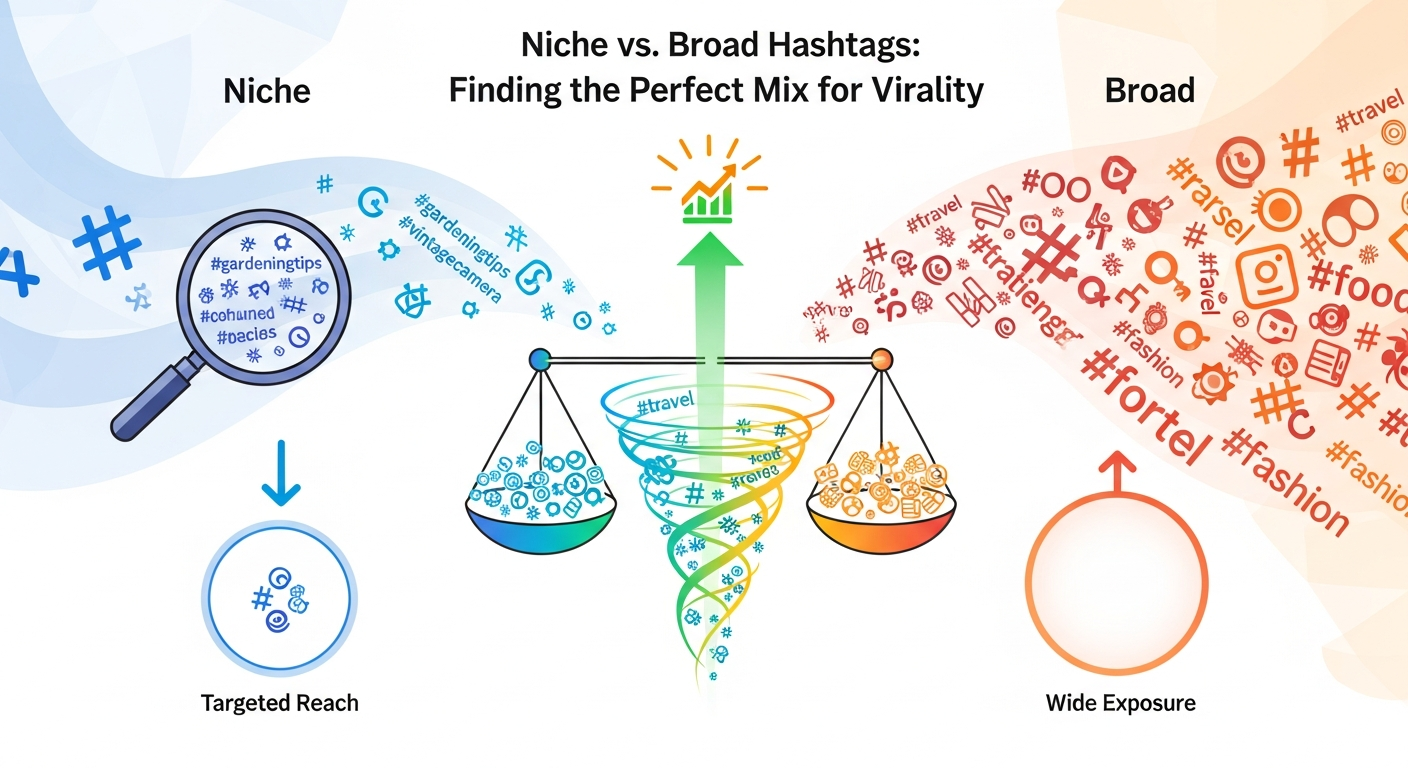
Ever wonder why some social media posts explode while others disappear? Hashtags are a crucial factor. Imagine crafting the perfect Instagram post with stunning visuals and a captivating caption, only to see it ignored. Frustrating, right? You’re not alone. Many creators pour their hearts into content, only to be lost in the internet’s noise.
The problem? You’re likely missing a vital ingredient: a strategically crafted hashtag strategy.
The secret to unlocking viral potential isn’t just slapping a few popular terms at the end of your caption. It’s about understanding the power of both niche hashtags and broad hashtags and knowing how to combine them effectively for maximum impact.
Hashtags are essentially keywords that categorize your content, making it discoverable to users searching for specific topics. Broad hashtags cast a wide net, while niche hashtags laser-focus on specific interests. The magic happens when you strategically combine the two.
The key to social media success lies in understanding and strategically combining niche and broad hashtags to maximize reach, engagement, and ultimately, growth. This isn’t just a theory; it’s a proven strategy that can transform your social media game. So, let’s dive in!
Understanding Broad Hashtags: Casting a Wide Net for Visibility
What exactly are broad hashtags? Think of terms like #travel, #food, #photography, #fashion, and #fitness. These are general, high-volume terms that encompass a large segment of users. They’re the digital equivalent of shouting into a crowded stadium.
The Upsides:
- High Search Volume and Potential Reach: Millions of posts are tagged with #travel daily. This means a massive audience could see your content.
- Easy to Find and Use: They’re widely known and require minimal research. Everyone understands #food or #photography.
- Introduces Content to a Wider Audience: If your post is truly outstanding, it could break through the noise and reach users beyond your immediate circle.
The Downsides:
- High Competition, Difficult to Stand Out: Your post will compete with thousands of others using the same hashtag, diluting its visibility. Getting noticed in that sea of content is tough!
- Lower Engagement Rates Due to Generic Content: Users searching broad hashtags are often overwhelmed with options and less likely to engage with individual posts. They’re scrolling quickly, looking for something specific.
- Risk of Getting Lost in the Noise: The lifespan of a post using only broad hashtags is often incredibly short – measured in seconds or minutes.
Examples of Broad Hashtags:
- Travel: #travel, #travelgram, #wanderlust, #vacation, #explore
- Food: #food, #foodporn, #instafood, #delicious, #yummy
- Photography: #photography, #photooftheday, #instagood, #art, #nature
- Beauty: #beauty, #makeup, #skincare, #fashion, #beautiful
Data Insight: Studies show that posts using only broad hashtags often experience a sharp initial spike in impressions followed by a rapid decline. The initial burst is exciting, but the lack of sustained engagement can be disheartening.
Understanding Niche Hashtags: Finding Your Tribe for Targeted Engagement
Niche hashtags are the opposite of broad – they’re highly specific terms that cater to a smaller, more engaged audience. Think #travelblogger, #veganrecipes, #landscapephotography, #sustainablefashion, or #crossfitgirls. They’re like whispering in a room full of people who really want to hear what you have to say.
The Upsides:
- Targeted Audience and Higher Engagement Rates: Users searching #veganrecipes are specifically looking for plant-based culinary inspiration, making them more likely to like, comment, and save your post.
- Less Competition, Increased Visibility: You’ll face significantly fewer competitors vying for attention under a niche hashtag.
- Builds a Community Around Specific Interests: Using niche hashtags allows you to connect with like-minded individuals and establish yourself as an authority.
- Attracts Relevant Followers and Customers: If you’re a vegan bakery, using #veganbakery and #vegancake will attract customers actively searching for your products.
The Downsides:
- Lower Search Volume and Potential Reach: The pool of users searching #landscapephotography is smaller than those searching #photography.
- Requires More Research to Find Relevant Niche Hashtags: You’ll need to delve into industry-specific terms and community jargon.
- May Limit Exposure to a Wider Audience: Relying solely on niche hashtags might prevent your content from reaching a broader audience who might be interested but weren’t actively searching for it.
Examples of Niche Hashtags:
- Travel: #budgettraveltips, #femaletravelblogger, #luxurytraveladvisor, #solotraveler
- Food: #glutenfreerecipes, #ketodiet, #plantbasedprotein, #easyveganrecipes
- Photography: #aerialphotography, #blackandwhitephotography, #wildlifephotography, #streetphotography
- Beauty: #crueltyfreemakeup, #organicbeautyproducts, #kbeautyaddict, #makeuptutorial
The Power of the Perfect Mix: Combining Broad and Niche Hashtags for Optimal Results
Think of broad hashtags as the amplifier and niche hashtags as the targeting mechanism. The amplifier broadcasts your signal, while the targeting mechanism ensures it reaches the right ears.
So, how do you find the perfect balance of niche vs. broad hashtags?
A good starting point is the 80/20 rule: 80% niche hashtags, 20% broad hashtags. For example, if you’re using 10 hashtags, 8 should be niche-specific, and 2 should be broader. You can also consider these ratios:
- Brand Building: 70% Niche, 20% Broad, 10% Branded
- Rapid Growth: 50% Niche, 40% Broad, 10% Trending
Consider the user’s journey. What are they thinking about when they discover your content? What search terms are they most likely to use?
Tailoring Your Hashtag Strategy to Different Platforms:
- Instagram: Focus on visual appeal and community building. Use a mix of niche, broad, and location-based hashtags.
- Twitter: Emphasize trending topics and news-related hashtags. Limit hashtag usage to 1-3 per tweet.
- TikTok: Leverage trending challenges and sound-based hashtags. Focus on creating engaging and shareable content.
Practical Use Case: A small clothing boutique targeting Gen Z could use hashtags like: #fashion (broad), #genzfashion (niche), #affordablefashion (niche), #sustainablefashion (niche), #boutiqueshopping (niche), #newarrival (niche), #style (broad).
How to Research and Find the Best Hashtags for Your Content
- Social Media Platform’s Search Function: Start by typing in a broad keyword. See what hashtags are suggested and explore related hashtags.
- Hashtag Analytics Tools: (e.g., RiteTag, Hashtagify, Keyhole, Flick.tech): These tools provide data on hashtag popularity, related hashtags, and potential reach.
- Analyzing Competitor’s Hashtags: See what hashtags your competitors are using and analyze their performance.
- Staying Up-to-Date on Trending Hashtags: Follow industry news and social media trends. Google Trends is also useful.
Advanced Hashtag Strategies for Social Media Growth
- Creating Branded Hashtags: A branded hashtag is unique to your brand and encourages users to share content related to your brand (e.g., #NikeRunClub, #GoPro). Practical Use Case: A local coffee shop could use #YourCoffeeShopName to encourage customers to share photos.
- Participating in Relevant Hashtag Challenges and Campaigns: Hashtag challenges are a great way to increase brand awareness and engagement.
- Using Location-Based Hashtags: Target your audience based on location. Use hashtags like #LondonRestaurants, #NYCevents, #MiamiBeach.
Common Hashtag Mistakes to Avoid on Social Media
- Using irrelevant or spammy hashtags.
- Overusing hashtags (hashtag stuffing).
- Ignoring hashtag performance data.
- Using the same hashtags for every post.
- Using banned hashtags. (Check a list of banned hashtags regularly!)
Real-World Examples: Successful Hashtag Campaigns
- Dove’s #RealBeauty: Combined the broad concept of beauty with the niche focus on celebrating diverse body types.
- Always’ #LikeAGirl: Challenged gender stereotypes and empowered young girls.
- REI’s #OptOutside: Encouraged people to spend time outdoors instead of shopping on Black Friday.
These campaigns succeeded because they were authentic, relevant, and had a clear message. They used hashtags to amplify that message and connect with their target audience on a deeper level.
FAQ: Your Hashtag Questions Answered
Q: How many hashtags should I use on Instagram for best results?
A: While Instagram allows up to 30, a sweet spot is usually between 5-10. Focus on quality over quantity.
Q: How often should I change my hashtags to optimize reach?
A: Vary them with each post, especially if you’re posting frequently on the same topic. Avoid using the exact same set every time.
Q: Are hashtag generators useful for finding relevant hashtags?
A: They can be a good starting point for brainstorming, but always vet the suggestions. Some generators suggest irrelevant or low-quality hashtags.
Q: How do I find out if a hashtag is banned from use?
A: Search the hashtag on the platform. If it’s banned, you’ll typically see a message stating that posts with that hashtag are hidden or removed. Regularly updated lists are also available online.
Q: Should I put hashtags in the caption or as a separate comment for better engagement?
A: Instagram treats both the same. Some people prefer adding them in a comment for aesthetic reasons.
Conclusion: Mastering the Art of Hashtags for Social Media Success
Mastering the art of hashtagging is about balance. Broad hashtags expand your reach, while niche hashtags hone in on your ideal audience. A strategic combination of both, combined with regular analysis and adaptation, is the key to unlocking viral potential on social media.
In today’s competitive social media landscape, a well-planned hashtag strategy is no longer optional; it’s essential for success. Consider exploring other social media marketing strategies for a comprehensive approach. Learn about social media content calendars here.
Ready to level up your social media game with a winning hashtag strategy?
Start experimenting with these strategies today and watch your social media presence grow! Don’t forget to track your results and adjust your strategy as needed.
About Author
Susha Kanaujia
Product Manager and AI enthusiast with 16+ years of experience in technology and digital products.
Is Your LinkedIn Profile Holding You Back?
Get an instant AI audit of your headline, About section, and keywords. Discover exactly what recruiters see and get 1-click Before & After rewrites to rank higher in searches.
+42% Recruiter Views predicted if you fix 3 keyword gaps.
🚀 Enjoying AICreatify?
We'd love your support on Product Hunt. ❤️ Upvote us and share your feedback.