Improve Your LinkedIn Profile for Recruiters: A Growth Hacking Guide

sushakanaujia
Author
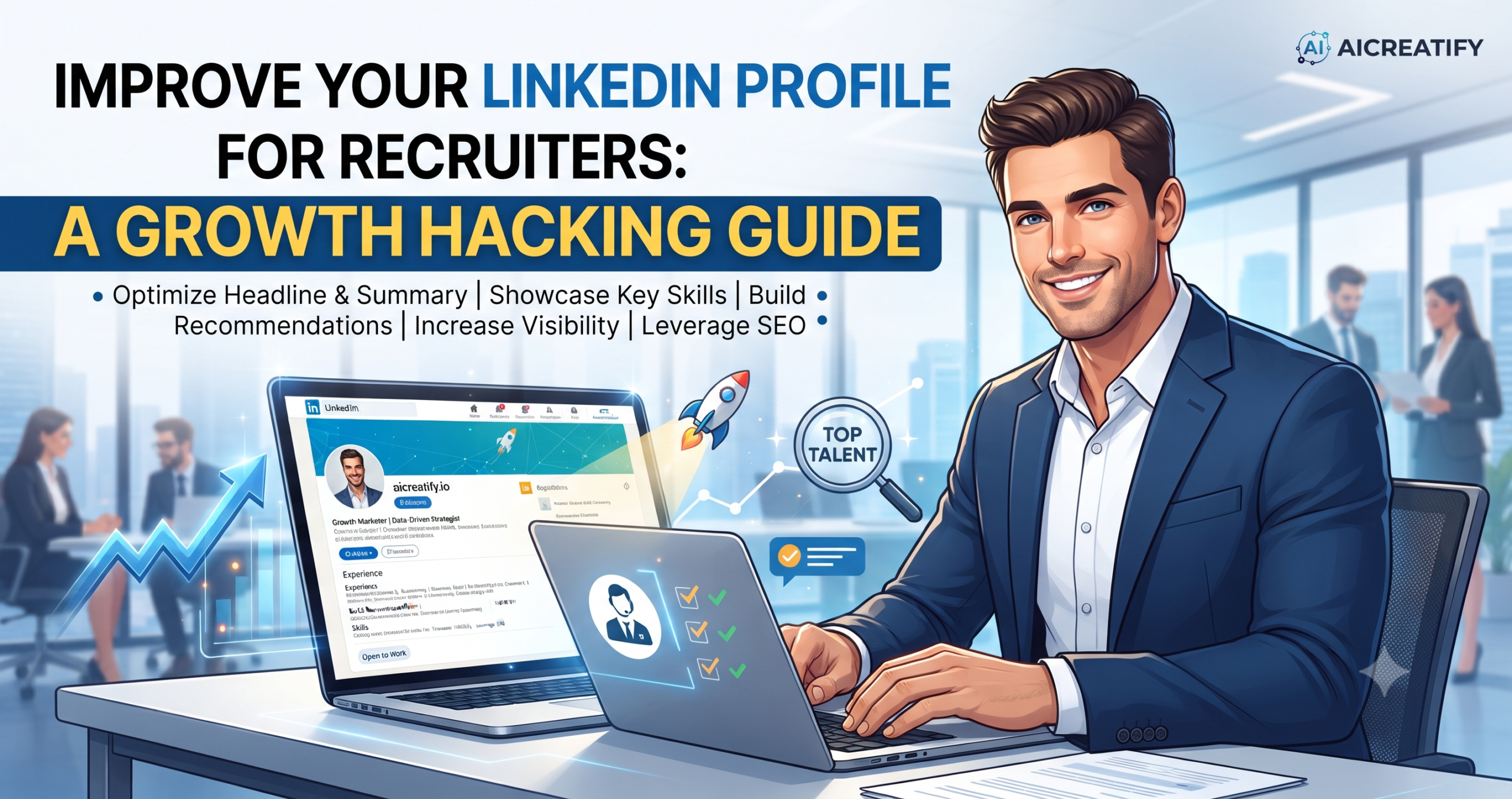
Alright, let’s cut to the chase. You think your LinkedIn profile is doing its job, right? You probably spent an hour or two on it, copied some stuff from your resume, and figured, “Done. The jobs will come.” Nope. That’s probably why you’re still scrolling job boards instead of getting InMail messages from dream companies.
Here’s the thing: Recruiters aren’t leisurely browsing. They’re on a mission, usually with a strict quota and about 6 seconds to decide if you’re worth another look. Yeah, six. As in, one Mississippi, two Mississippi… and you’re either in or out. Eye-tracking studies confirm this, and recruiters are basically speed demons. So, if your LinkedIn profile isn’t improved to grab their attention instantly and scream “hire me!” without you lifting a finger, if it’s not truly recruiter-friendly, you’re missing out. Big time.
Forget the tired advice you’ve heard. We’re talking real growth hacking for your personal brand on LinkedIn. This isn’t just about making you visible; it’s about making you utterly irresistible to the right people. Let’s do this.
Your First Impression Game: Winning in Six Seconds Flat
That 6-7 second rule from The Ladders? It’s brutal, but it’s your reality. You don’t get a second chance to make a first impression, especially when there are hundreds, if not thousands, of other profiles floating around. So, your immediate visual and headline hit has to be perfect.
Photo & Banner: It’s Not a Dating App, But Optics Matter
Listen, your profile picture isn’t just a nice-to-have. It’s the first thing recruiters see, and it can literally make or break whether they stick around. LinkedIn’s own data says profiles with a professional headshot get 21 times more profile views and 9 times more connection requests. Think about it: a blurry selfie from your cousin’s wedding? Instant swipe left. A professional, friendly, well-lit shot? That signals you’re serious, approachable, and polished.
And that banner image at the top? Don’t leave it blank! It’s prime real estate. Use it to subtly hint at your industry, your personal brand, or a core value. Think about a custom graphic related to “SaaS Growth Marketing” or “Driving Innovation.” It’s an easy, overlooked way to add instant credibility.
Your Headline: More Than Just a Title
You’ve got a job title, sure. But is that all you’re? “Marketing Manager” is kinda boring, isn’t it? Your headline needs to be a mini-ad for yourself. This is where those keywords start to live. Recruiters use specific terms to find talent, and if your headline doesn’t have them, you won’t even show up in their searches. Strong, keyword-rich headlines can bump your search appearances by up to 30%. That’s free marketing for you.
Don’t just write “Product Manager at [Company X]”. Try something like: “Growth Product Manager | B2B SaaS Expert | Driving 25% User Engagement | Seeking Smart Challenges”. See? It’s punchy. It tells them what you do, your specialty, your impact, and what you’re looking for – all in a single glance.
The “About” Section: Your Elevator Pitch on Steroids
This isn’t a place to ramble. It’s your story, condensed. Make it count. Use the first 1-2 sentences to hook them, just like an email subject line. But what’s your superpower? What problem do you solve? Then, naturally weave in those target keywords we talked about. This section should read like a strategic overview, not a chronological list of duties. Focus on impact and vision. A completely full profile is no joke – profiles that are 100% complete are 40 times more likely to get opportunities. That stat alone should make you hit “edit profile” right now.
Beating the Bots: Making Your LinkedIn Profile Recruiter-Friendly with ATS Hacking
Think humans are making all the initial screening calls? Nope. A terrifying 75% of job applications get rejected by Applicant Tracking Systems (ATS) before a human even sees them. Why? Keyword mismatch. These bots are brutal. If your profile doesn’t speak their language, you’re invisible.
Keywords Aren’t “Cheating,” They’re Smart
This isn’t about stuffing your profile with jargon; it’s about being strategic. Grab 5-7 job descriptions for the roles you actually want. What words pop up repeatedly? Not just job titles, but skills, responsibilities, tools, and industry buzzwords. Is it “client acquisition” or “customer success”? “Market analysis” or “data-driven insights”? Mirror that language exactly.
Pro-tip: Look, you can literally reverse-engineer what the recruiters are looking for. What if you had a tool that helped you craft posts and identify trending topics that automatically catch their eye? You’re playing against algorithms here, so having an edge in your content strategy, and even just your post hooks, can make a difference. LinkedIn Hooks for Founders, for instance, helps you generate viral post templates that keep engagement high. Check it out and see how it works for you.
The Skill Section: Don’t Just List, Stack the Deck
You’ve got a skills section for a reason. But don’t just dump everything there. Focus on the most relevant skills from your target job descriptions. LinkedIn tells us that listing at least 5 relevant skills can increase your chances of getting messaged by a recruiter by up to 27 times. That’s a huge bump for minimal effort.
Then, do yourself a favor: ask colleagues and former managers for endorsements on those specific skills. An endorsement isn’t just a tick; it’s social proof that you actually possess that skill. Think of it as a mini-recommendation without the effort of writing a whole paragraph.
From Passive Observer to Proactive Powerhouse
Okay, your profile looks amazing now. Great. But that’s just step one. You can’t just set it and forget it and expect magic. The growth marketing mindset means you’re actively engaging, nurturing, and expanding your reach. This means networking, thought leadership, and making your presence felt.
This one’s underrated.
Why Being a “Content Machine” (Even a Small One) is a Game-Changer
You’ve improved your static profile. Now make it dynamic. LinkedIn isn’t just a digital resume; it’s a social network. Actively sharing industry insights or dropping thoughtful comments on relevant posts can boost your profile visibility and inbound messages by 20-50%. That’s a stat from actual growth marketing case studies. That’s huge for job seekers, especially in competitive fields.
You don’t need to write a whitepaper every week. Share an article, add your two cents, ask a relevant question. Start a conversation. Post a quick observation about a trend. It shows you’re engaged, knowledgeable, and not just another passive profile.
Networking: It’s Not What You Know, It’s Who Knows You (And What They Know About You)
We all know this, but sometimes we forget how vital it’s on a platform like LinkedIn. 85% of all jobs are filled via networking. Eighty-five percent! So, just applying online? You’re playing against seriously stacked odds.
Connect with people in your target companies, target roles, and even executive recruiters. Don’t just send a generic “I’d like to connect.” Personalize it. Mention something specific from their profile or a piece of content they shared. It shows you did your homework. But when you connect, follow up. But ask a thoughtful question. Build real connections, not just a high number of contacts. This is where recruiters will eventually find you, not just through search, but through referrals and network effects.
Recruiters are actively looking for talent, that’s why their InMail response rate is a respectable 10-25% – way higher than cold emails. When your profile is top-notch, it makes their job easier, and they’re more inclined to reach out.
Growth Hacks from the Pros: Who’s Doing It Right?
Let’s look at some real-world examples of how people and companies are using these principles to grow. This isn’t theoretical; this is happening.
Austin Belcak: The Content King Who Skips the Resume Line
Ever heard of Austin Belcak from Cultivated Culture? This guy built an entire brand teaching people how to job hunt unconventionally. And a massive part of his success, and what he teaches, is using LinkedIn as a dynamic personal brand platform, not just a static resume.
What he did: Austin didn’t wait to be found. He consistently published actionable, data-backed content – posts, articles, videos – about job searching, resume improvement, and interview prep. He literally reverse-engineered recruiter psychology and ATS mechanics and shared those insights. He wasn’t just on LinkedIn; he was owning LinkedIn.
The growth hack: He analyzed what content resonated, what questions people asked, and he tailored his output. He became the go-to expert. For a job seeker, this means not just having an improved profile, but actively creating and sharing content that speaks to recruiters and hiring managers. His clients regularly secure interviews at top companies within weeks, often bypassing traditional application processes entirely. It’s truly a game-changer.
GitLab: Decentralized Employer Branding as a Talent Magnet
GitLab, a fully remote company, absolutely crushes it with employer branding. But they don’t just have a shiny company page. They encourage every single employee (they call them “GitLabbers”) to be vocal on LinkedIn about their work, their culture, and their expertise.
What they did: GitLab provides resources and encourages its employees to regularly update their profiles, share company news, discuss projects, and engage with industry content. They emphasize quantifying achievements and showcasing unique aspects of their remote-first culture.
The growth hack: This decentralized strategy means when a recruiter hunts for a “Senior Software Engineer” with specific skills. They’re not just finding a profile; they’re finding a “GitLabber” whose profile is rich with context, projects, and endorsements, reflecting a company known for innovation. This collective personal branding of their employees acts as a powerful, organic recruitment funnel, reducing reliance on expensive external recruiters and keeping their inbound applicant flow strong. It’s genius.
AI-Powered Improvement Firms: Because Bots Beat Humans
Companies like TopResume have made a whole business out of something incredibly savvy: they use data analytics and AI to reverse-engineer recruiter search logic and ATS algorithms.
What they do: They’ve built algorithms that analyze millions of job descriptions and successful profiles. They identify trending keywords, optimal phrasing, and structural elements that appeal to both AI screening systems and human recruiters.
Stick with me here.
The growth hack: They essentially productized the “algorithmic eye” concept. Their tools can score profiles against target job descriptions, giving detailed recommendations. Think keyword density analysis, impact statement generation, even sentiment analysis for your “About” section. They transform generic profiles into hyper-targeted, algorithmically improved assets. Their clients often report a 2.2x increase in interviews. It proves that a data-first approach isn’t just nice-to-have; it’s a measurable ROI driver.
Sarah’s LinkedIn Lighthouse Campaign: Making Your LinkedIn Profile Recruiter-Friendly for Executive Roles
Alright, enough theory. Let’s make this real. Meet Sarah. She’s a mid-career pro, crushing it, but she wants Director-level roles in SaaS. She’s gonna use this advice to attract executive recruiters like a magnet. This isn’t just a list; it’s a step-by-step campaign.
Objective: Increase inbound recruiter messages for Director-level roles by 30% within 60 days, focusing on specific target industries.
Phase 1: Deep Dive & Algorithmic Alignment (Weeks 1-2)
- Target Role Deconstruction (1-3 days):
- Action: Sarah’s gonna find 5-7 dream Director-level job descriptions. Not just scan them – she’s tearing them apart.
- Execution: She’ll use a keyword analyzer (even a simple word cloud generator works, or something like Jobscan.co) to pull out the hard skills, soft skills, responsibilities, and industry jargon repeated most often. Think “SaaS growth,” “P&L management,” “cross-functional leadership.”
- Output: Her “Master Keyword List.” This list is gold.
- Profile Audit & Gap Analysis (3-5 days):
- Action: Meticulous review of her existing profile against that Master Keyword List and the “Algorithmic Eye” principles we just talked about.
- Execution:
- Headline: Refine, refine, refine. Instead of “Marketing Manager,” it’s now “Growth Marketing Leader | SaaS & FinTech | Driving 30% ARR Growth | Seeking Director Roles.” That makes so much sense.
- About Section: Rewrite it. Make it a 3-paragraph story about her impact, naturally weaving in those keywords. Focus on strategic vision, not just tasks. Target a keyword density of around 1-2% for critical terms. You want it to sound natural, not robotic.
- Experience: For each relevant role, bullet points? Those are out. STAR (Situation, Task, Action, Result) statements are in. Quantify everything. “Led a cross-functional team of 8 to launch a new B2B SaaS product, resulting in a 40% increase in qualified leads and 15% reduction in customer acquisition cost within 6 months.” – See the difference? Keywords + numbers.
- Skills: Prioritize the top 10-15 from her Master Keyword List. Remove anything outdated. Get colleague endorsements for those exact skills. Go ask for ’em!
- Visual & Credibility Refresh (2-3 days):
- Action: Update her professional headshot and banner.
- Execution: High-res photo, approachable. Banner subtly hints at her industry or brand. Then she needs 2-3 new recommendations from previous managers or senior peers. She’ll specifically ask them to highlight leadership, strategic thinking, and quantifiable achievements that fit Director-level competencies. These aren’t just warm fuzzy feelings; they’re measurable testimonials.
Phase 2: Targeted Engagement & Thought Leadership (Weeks 3-6)
- Content Curation & Creation (Ongoing, 2-3x/week):
- Action: Sarah’s going to find 3-5 VPs, Directors, and executive recruiters she admires, plus 2-3 industry publications.
- Execution:
- Engagement: Daily, 15-20 minutes. Genuinely comment on their posts. Add real value, not just “great post!” Aim for thoughtful comments that show her expertise. You want top comments because they get more visibility.
- Original Posts: Two or three short-form posts a week. These aren’t essays. They could be quick analyses of industry trends (“The Rise of AI in FinTech and Its Impact on Customer Acquisition”). Behind-the-scenes insights (anonymized, of course, but highlighting her strategic role), or sharing an article with a provocative question to get people talking.
- Growth Hack: She’s going to A/B test different headline hooks for her posts. Question-based vs. statement-based. Track likes, comments, shares in LinkedIn Analytics. What works best for her audience? That’s how you learn.
- Strategic Network Expansion (Ongoing, 5-10 connections/week):
- Action: Identify 50-100 target recruiters (Executive Recruiter, Director of Talent Acquisition at target companies) and 50-100 target hiring managers. LinkedIn Recruiter Lite helps here, but manual Boolean search strings work too.
- Execution: Send personalized connection requests. Ditch the default.
- For Recruiters: “Hi [Name], your post on [topic] was spot-on. As a [her current title] who’s achieved [specific result], I’d value connecting to understand the talent market in [her industry].”
- For Industry Leaders: “Hi [Name], loved your article on [topic]. Your perspective on [specific point] really resonated. I’d be grateful to connect and follow your insights.”
- Growth Hack: After they connect, send a simple “Thanks for connecting! I’m particularly passionate about [her expertise] and expanding my network. What trends are you seeing right now?” This opens a dialogue, makes you memorable.
Phase 3: Performance Tracking & Iteration (Ongoing, Weekly Review)
- KPI Monitoring (Weekly):
This part surprised me too.
- Action: Sarah is checking LinkedIn’s “Who’s Viewed Your Profile” and “Search Appearances” dashboards.
- Metrics: Profile views (week-over-week), search appearances (and the keywords people use to find her!), inbound recruiter messages (this is the big one, her conversion metric), and engagement rates on her posts.
- Reporting: Simple spreadsheet. Log numbers weekly. Look at trends.
- A/B Testing & Improvement (Bi-Weekly):
- Action: Based on her data, Sarah iteratively refines her strategy. This is where growth marketers live.
- Execution:
- If search appearances are low for target keywords, she tweaks her About/Experience sections.
- If certain posts get more engagement, she creates more of that type of content.
- If recruiter messages are stagnant, she might adjust her “Open to Work” settings or broaden her networking.
- Growth Hack: She’ll experiment with posting times. LinkedIn engagement often peaks on Tuesdays, Wednesdays, and Thursdays, 9 AM to 3 PM EST. Is that true for her audience? Test it. The same kind of testing you’d do to nail your Instagram content. Ever thought about improving those too? Our Instagram Caption Generator and Hashtag Generator can help you make those scroll-stopping as well, because your personal brand is bigger than just LinkedIn, right?
Expected Outcome: This isn’t a quick fix; it’s a systematic, data-driven campaign. By doing this, Sarah will turn her LinkedIn profile into an active “recruiter magnet,” drastically increasing relevant inbound opportunities. Because honestly, passive job seeking is for people who love waiting. We don’t.
Frequently Asked Questions
Q: Do I really need to be posting content if I just want a job?
A: Yes, you do. Think of it this way: your profile shows what you’ve done. Your content shows how you think. Recruiters are always looking for smart, engaged people who have unique perspectives. It shows thought leadership, keeps your profile active, and seriously boosts visibility. If you’re not posting, you’re missing a massive opportunity to stand out from the crowd.
Q: How often should I update my profile once it’s improved?
A: At least once a quarter, or whenever you’ve a significant achievement, new project, or skill to add. But the real magic happens if you do a quick keyword review every 3-6 months. Job market buzzwords change fast, and you want to keep your profile always fresh and aligned with what recruiters are actively searching for right now.
Q: Is it okay to use “Open To Work” on my profile? Some people say it looks desperate.
A: Honestly, it depends on your comfort level, but here’s the thing: The “Open To Work” banner can significantly increase your visibility to recruiters actively using LinkedIn Recruiter. You can customize who sees it (all LinkedIn members or just recruiters). If you’re genuinely looking for a job and want to speed up the process, enabling it for recruiters is a legit move. Don’t worry about looking “desperate” – you’re simply being efficient and signaling availability, which is useful information for recruiters.
Q: My industry isn’t very “social.” Does content creation still apply?
A: Absolutely! In niche or less “social” industries (like highly technical fields or certain B2B sectors), showing consistent, thoughtful engagement or sharing unique insights can make you stand out even more. There’s less noise, so your voice gets heard louder. You don’t need to go viral; you just need to provide value to your target audience (i.e., relevant recruiters and hiring managers in your field). Even one well-received post a month makes a difference.
About Author
Susha Kanaujia
Product Manager and AI enthusiast with 16+ years of experience in technology and digital products.
Is Your LinkedIn Profile Holding You Back?
Get an instant AI audit of your headline, About section, and keywords. Discover exactly what recruiters see and get 1-click Before & After rewrites to rank higher in searches.
+42% Recruiter Views predicted if you fix 3 keyword gaps.
🚀 Enjoying AICreatify?
We'd love your support on Product Hunt. ❤️ Upvote us and share your feedback.