
How to Write a Cover Letter That Matches the Job Description

sushakanaujia
Author
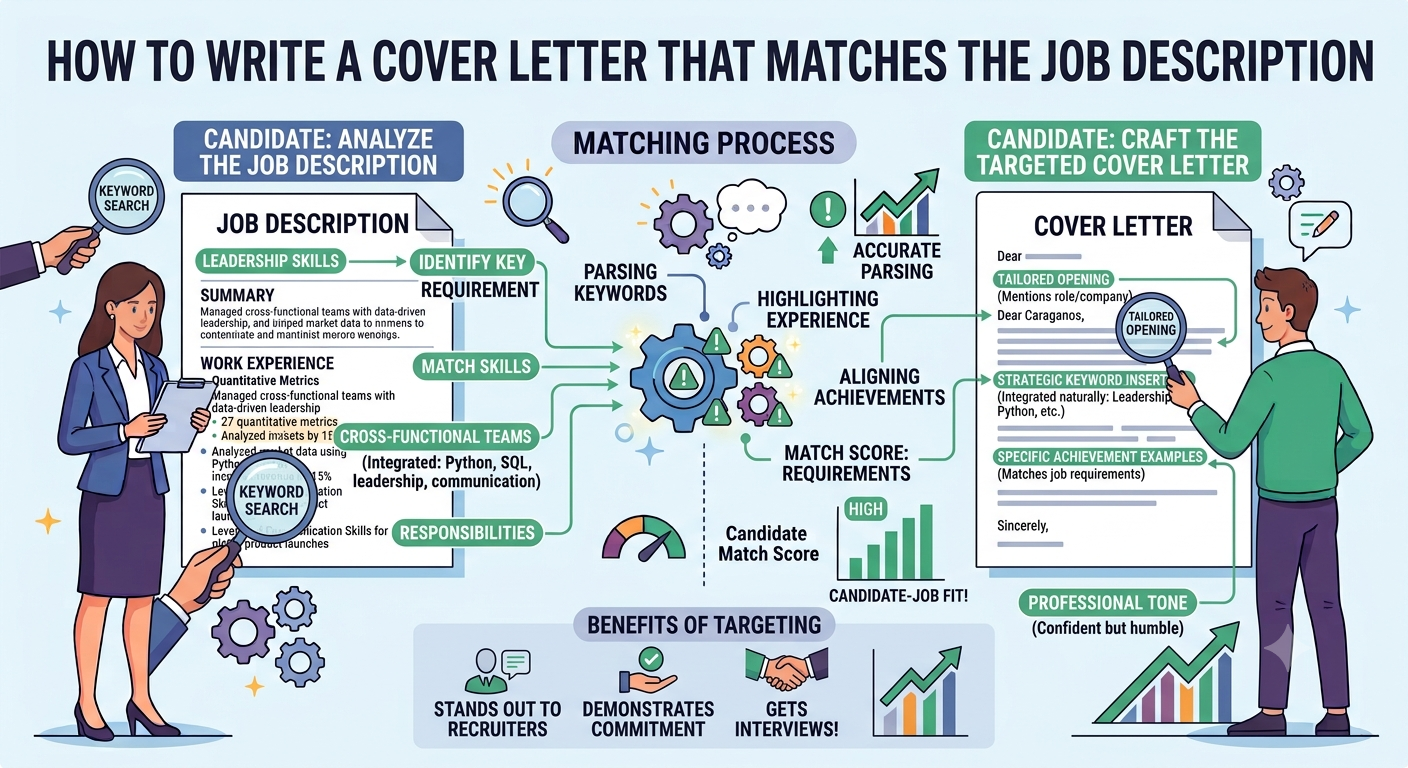
Let’s be real. If you’re still hitting “send” on a generic cover letter in October 2026, you might as well be sending carrier pigeons. The job market isn’t waiting for you to catch up; it’s moved on, powered by AI and laser-focused hiring managers. To actually write a cover letter that matches a job description now, you need to meticulously pick apart that job posting, identify every single requirement, and then—critically—weave your specific skills and accomplishments into a story that screams, “I’m not just a fit, I’m the fit.” It’s about showing direct value, not just checking boxes.
Key Takeaways
- Generic is Dead: Modern ATS and AI weed out non-tailored letters instantly.
- Matrix Your Match: Use the “JD-to-CL Matrix” to systematically align your experience with every job requirement.
- Show, Don’t Tell: Frame your skills as “value propositions” – demonstrate actual impact, not just duties.
- ATS is Smarter: Optimize for semantic understanding, not just keyword stuffing.
- Proofread Like a Boss: One typo can send your application straight to the reject pile.
I’ve spent years running social media and growth campaigns, and let me tell you, if you don’t personalize your outreach, you don’t get a response. The job market is no different. It’s not about finding a job; it’s about finding the right job, and they’re looking for the right person.
- The Critical Role of Advanced Applicant Tracking Systems (ATS) and AI in Initial Screening: Forget what you heard about ATS from a few years ago. In 2026, these aren’t just dumb keyword machines. Modern ATS, often pumped up with AI and Natural Language Processing (NLP), are your first, toughest gatekeepers. For many companies, big and small, these systems sift through applications. They now understand semantic relevance, contextual meaning, and even the sentiment of your writing. A generic letter screams “nope” to these smart systems before a human even sees it.
- Making an Authentic, Memorable First Impression with Human Hiring Managers: Pass the robots, now for the humans. A recruiter gives your application, generously, a few seconds. A tailored letter immediately signals you’ve done your homework, you’re genuinely interested, and you understand what they need. You move from “one of many” to “someone who gets it.”
- Moving Beyond Mass Applications to Demonstrating Genuine Interest and Proactive Problem-Solving: Employers aren’t just asking “Can you do the job?” anymore. They’re asking, “Do you want our job, and how will you immediately help us solve our problems?” A truly tailored cover letter isn’t just about ticking boxes; it’s about showing you’re already thinking about their challenges and how you’re the specific solution. My honest opinion? It’s not just about fitting in; it’s about demonstrating you’re the only logical choice because you’ve already started solving their problems in your mind.
Table of Contents
The JD-to-CL Matrix: Your Blueprint for a Perfect Match
This is my secret weapon for cutting through the noise. The “JD-to-CL Matrix” (Job Description to Cover Letter Matrix) is a pre-writing framework. It forces you to get systematic, so you don’t miss anything, and you show up with specific, evidence-backed qualifications every single time. No more generic fluff.
- Step 1: Deconstruct the Job Description: Don’t just skim. Copy the whole thing. Print it out. Highlight, scribble, get messy. What are the:
- Core Responsibilities: The day-to-day stuff.
- Required Skills & Qualifications (Must-Haves): No negotiating here. These are your non-starters.
- Preferred Qualifications (Nice-to-Haves): What makes you shine a little brighter.
- Underlying Company Values/Culture: Look for words like “collaborative,” “innovative,” “customer-centric,” “results-driven.” This tells you about the vibe they want.
- Implicit Needs: What problem is this role really trying to solve? Read between the lines, think like them.
- Step 2: Create Your Matching Matrix: Open a simple two-column table. Seriously, this works.Job Requirement/Value | My Relevant Experience/Skill/Achievement (with specific Impact/Metric)
- Step 3: Populate the Matrix with Precision: Go through every single point from your deconstruction. For each job requirement, dig into your past. Don’t just list a skill. Connect it to a project, a specific achievement, a quantifiable result. If you don’t have a direct match, think about transferable skills. Say you run a content business, you can use AICreatify’s free LinkedIn Hooks for Founders tool to brainstorm how your content applies to a specific client. This matrix helps you connect your dots to their needs.Example from a “Growth Marketing Manager” JD:
- “Develop & execute SEO strategy” | “Increased organic traffic by 40% in 12 months at [Company X] via technical SEO and content cluster build-out.”
- “Manage paid ad campaigns (Google/Meta)” | “Optimized Google Ads for [Client Y], reducing CPA by 18% while scaling spend 2x.”
- “Collaborate with product teams” | “Partnered with product to launch 3 new features, driving 15% adoption in first month through targeted in-app messaging.”
Step-by-Step: How to Write Your Matched Cover Letter
1. Craft a Powerful Introduction That Demands Attention
This is your hook. Make it count.
- Clearly state the specific position you’re applying for and where you learned about it. Professional, direct.
- Immediately highlight 1-2 of your strongest, most relevant qualifications. What’s your absolute best, most direct match? Lead with that.
Copy-Paste-Ready Hook Example:
“Having closely followed [Company Name]’s impressive scale in [specific industry area, e.g., AI-driven productivity solutions] and seen your opening for a [Job Title, e.g., Head of Growth] on [Platform, e.g., LinkedIn], I was immediately drawn to the opportunity. I bring [X years] of experience specifically in [specific skill, e.g., scaling B2B SaaS ARR], which has delivered [quantifiable result, e.g., a 200% YOY revenue increase in a previous role], directly aligning with your stated need for ‘a leader who can significantly accelerate market share and drive aggressive expansion’.”
2. Body Paragraphs: Demonstrate Fit with “Value Proposition” Stories
This is where you show your worth, not just your resume points. Use your JD-to-CL Matrix as your North Star.
- Dedicate each body paragraph to a key theme or cluster of requirements from the job description. Maybe one paragraph covers technical skills, another focuses on leadership or client management.
- Instead of merely stating a skill, show how you used it to achieve impact. This is the “Value Proposition” approach. You’re not just saying you have a skill; you’re showing the return on investment for your future employer.
- Generic Statement: “I have strong project management skills.”
- Value Proposition Story: “My approach to project management at [Previous Company] involved implementing an agile framework that cut project delivery times by 25% and boosted team efficiency by 18%. This directly addresses your need for a leader who can ‘optimize operational workflows and ensure timely, high-quality project execution’—I’ve done it.”
- Use the STAR method (Situation, Task, Action, Result) for concise, compelling anecdotes. It’s easy to follow and highlights your actual contributions.
3. Optimize for ATS and Human Readers Simultaneously
This isn’t about gaming the system; it’s about making sure your message actually gets through.
- Strategic keyword and semantic integration: Naturally weave core keywords, related terms, and synonyms from the JD throughout your letter. If they say “customer success,” also use “client retention” or “post-sales engagement.” Modern ATS (and smart humans) appreciate this depth. My team uses tools to help us brainstorm related keywords when we’re writing content, and the same principle applies here. You can learn more about this in our post on How to Use Keywords Effectively in 2026.
- Beyond simple keyword density: Modern ATS, thanks to NLP, understand much more than just a word count. They parse phrase matching, contextual relevance, and sentence structure. “I used `Python` for `data analysis` to identify `customer churn` patterns, leading to a `targeted retention strategy`” is light-years ahead of just listing “Python, data analysis, customer churn, retention strategy.” Focus on demonstrating actual competency.
- Formatting tips for optimal ATS readability in 2026:
- Standard Fonts: Please, no fancy script fonts. Calibri, Arial, Times New Roman, or Georgia. Keep it professional.
- Clear Headings & Paragraphs: Use standard breaks. Avoid complex tables or text boxes; they confuse parsers.
- Consistent Structure: Standard business letter format. Don’t reinvent the wheel here.
- File Type: PDF is usually best to preserve formatting, but make sure it’s a searchable PDF (actual text, not an image scan). Always follow specific instructions if they ask for Word docs.
- Avoid Graphics/Images: Unless explicitly requested, keep it text-only. Graphics can absolutely break ATS parsing.
4. Conclude with a Forward-Looking Call to Action
End strong. Reiterate your value and ask for the next step.
- Reiterate your enthusiasm for the role and the company. Briefly highlight your top 1-2 qualifications again, directly linking them to the company’s needs.
- Confidently express your interest in an interview. You know you’re a fit; now get them to agree.
- End with a professional closing. “Sincerely” works every time.
Copy-Paste-Ready Call to Action:
“I’m confident that my blend of [key skill 1, e.g., ‘data-driven growth strategies’] and [key skill 2, e.g., ‘proven team leadership’], as demonstrated by [brief specific impact statement], makes me an ideal candidate to contribute significantly to [Company Name]’s objectives, particularly in [specific goal from JD or company mission]. I’m genuinely eager to discuss how my track record can directly support your team’s success and welcome the opportunity for an interview. Thank you for your time and consideration.
Sincerely,
[Your Name]”
Real-World Examples: Brands & Creators Applying “Tailored Value”
Nobody writes cover letters quite like job applicants. But the principle of meticulously tailoring your pitch to solve a specific client’s or audience’s needs? That’s the hallmark of every successful brand and creator out there in 2026.
- Salesforce (B2B SaaS): When Salesforce pitches huge enterprise clients, they don’t just trot out product features. Their account executives dig into public statements, earnings calls, strategic objectives, and competitive analyses—basically, they create a “job description” for the client’s problem.What they do: A Salesforce AE won’t lead with, “Our CRM is great.” Instead, they might open with, “We noticed your Q2 earnings call emphasized ‘reducing customer service friction by 15% and increasing retention.’ Our recent implementation with [similar industry client Y] integrated Service Cloud with Einstein AI, cutting average resolution time by 12% and boosting CSAT by 8% in just six months. We believe our solution can directly help you hit your Q3 targets.” This is the JD-to-CL Matrix and Value Proposition in action.
- Animalz (Content Marketing Agency): As a high-end content marketing agency, Animalz never sends out templated proposals. When they pitch a client, they’re essentially “applying” for the role of their content strategist. They deep-dive into the client’s existing content, SEO performance, audience, and business goals.What they do: Instead of a generic “We write amazing blog posts,” their proposal might state, “Our audit of your current content revealed a significant gap in capturing market share for [specific long-tail keyword cluster] where competitors [X] and [Y] are currently dominating. Our proposed strategy for [specific content pillar, e.g., expert-led industry reports] combined with our distribution framework has consistently driven [Z]% organic traffic growth and [W]% lead-to-MQL conversion for similar SaaS clients, directly addressing your stated need for ‘accelerated organic growth and improved lead quality from content’.” This is understanding the “job description” (client’s business needs) and offering a “value proposition” solution.
Common Mistakes When Matching a Cover Letter to a Job Description
I’ve seen it all in my years of reviewing pitches and applications. Don’t make these blunders:
- Simply copying and pasting sentences directly from the job description: This isn’t tailoring; it’s plagiarism. Both ATS (yes, they can sometimes detect this) and human readers will instantly see it as lazy. My honest take? Your ‘personalization’ shouldn’t be obvious ‘tailoring’; it should feel like you genuinely belong, like you naturally speak their language, not just parrot it back.
- Focusing solely on your duties instead of quantifiable achievements and impact: Nobody cares what you did as much as what happened because you did it. “Responsible for managing social media” is weak. “Grew social media engagement by 300% and generated 500+ MQLs via targeted campaigns” is strong.
- Neglecting thorough proofreading for grammar, spelling, and tone errors: With AI writing tools everywhere in 2026, any error signals a lack of attention to detail. It’s an instant credibility killer. Use every tool at your disposal.
- Failing to research the company’s mission, values, and recent news: A great cover letter shows you understand their business, not just the job itself. Drop in a mention of a recent achievement or alignment with their values.
- Submitting a cover letter that reads like a condensed version of your resume: Your cover letter is where you expand on key points, add context, and tell stories your resume can’t. It’s about why your experience matters to them, not just what your experience is.
- Being generic and boring: This is the biggest mistake you can make. It’s not a typo; it’s being forgettable. If your cover letter sounds exactly like everyone else’s, you’ve already lost the attention battle.
Frequently Asked Questions
How do you match your cover letter to a job description?
Break down the job description into core requirements and desired qualifications. Create a “JD-to-CL Matrix” to systematically map each point to a specific, quantifiable experience or skill from your background. Then, write your letter addressing each point with specific examples, impact statements, and strategic keyword integration, focusing on how you solve their problems.
What should I put in my cover letter to match the job?
Highlight your most relevant skills, experiences, and achievements that directly correspond to the job’s required and preferred qualifications. Crucially, include quantifiable results and frame your contributions as value propositions—showing how you can add direct benefit to the hiring company. Always emphasize solutions and impact over mere duties.
Should a cover letter be tailored to each job?
Absolutely, yes. In 2026’s competitive and AI-driven job market, a generic cover letter is highly unlikely to pass initial ATS screening or impress a human hiring manager. Tailoring demonstrates genuine interest, a clear understanding of the role, and your specific suitability, significantly increasing your chances of securing an interview.
How do I use keywords from a job description in my cover letter?
Integrate them naturally into your sentences and paragraphs, avoiding keyword stuffing. Use synonyms and related phrases to demonstrate a broader understanding of the domain. Modern ATS and AI tools understand semantic relevance and context, so focus on naturally weaving keywords into compelling narratives that showcase your experience and application of those skills. Don’t just chase keywords; understand the intent behind them. A smart ATS in 2026 isn’t just counting words; it’s parsing meaning and contextual application.
What is a good length for a tailored cover letter?
Ideally, a tailored cover letter should be concise, professional, and fit on a single page, comprising 3-4 well-structured paragraphs. Prioritize quality, impact, and direct relevance over length. Aim for readability and conciseness, ensuring every sentence adds value and strengthens your case. My team often uses free tools like our Instagram Caption Generator (for brainstorming shorter, punchier text) to get in the mindset of “less is more” and ensure every word pulls its weight.
Getting your cover letter right in 2026 isn’t optional; it’s essential. Stop just applying and start strategically selling yourself as the solution to their problems. It takes a little more effort upfront, but it pays off exponentially in interviews.
What’s one thing you’re going to change about your cover letter strategy after reading this? Let me know!
About Author
Susha Kanaujia
Product Manager and AI enthusiast with 16+ years of experience in technology and digital products.
Check your resume against the job, free
Paste your resume and a job description to get an ATS match score, the keywords you're missing and a fix list.
Check My Resume — Free🚀 Enjoying AICreatify?
We'd love your support on Product Hunt. ❤️ Upvote us and share your feedback.